
RU-RU
Связаться с нами This is a dust bag with a reversible paper cap, made by Oltaven for robot vacuum auto-empty bases, handheld vacuums and commercial vacuum bins. Its multilayer composite PP meltblown media…
FILTER MEDIA / ROLLS · SHEETS · DIE-CUT
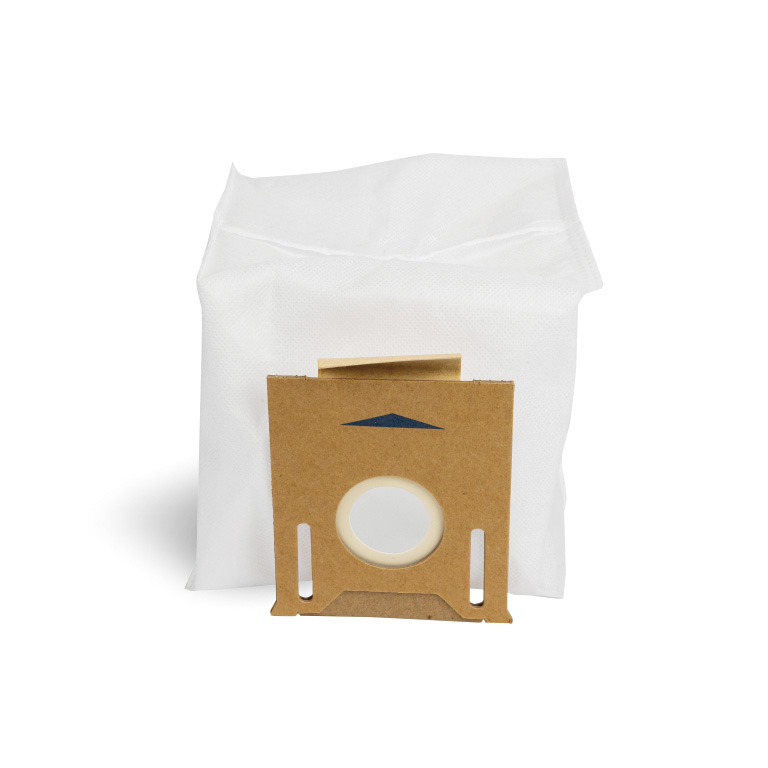
This is a dust bag with a reversible paper cap, made by Oltaven for robot vacuum auto-empty bases, handheld vacuums and commercial vacuum bins. Its multilayer composite PP meltblown media captures fine dust, mites and allergens, while the low-resistance design helps maintain suction. It is designed for appliance makers and vacuum brands that need a finished, custom-fit bag rather than raw media.
A dust bag is a finished filtration component, not a roll of fabric. The bag starts with a multilayer composite of polypropylene nonwoven and meltblown layers, sometimes with an antibacterial filter cotton layer. How those layers are pleated, combined and fixed to the bag body decides what the finished bag can do. The same media formed into a loose bag with poor seams will leak dust; formed into a tight, well-sealed bag with a smooth air path, it will hold particles and keep airflow steady.
Oltaven sells the finished bag. That means we control the forming steps: layer stacking, pleat or bag shaping, the cardboard or plastic cap interface, and the sealing that keeps the bag closed during removal. Each step affects efficiency, resistance and dust capacity in the final product.
The core material is a multilayer high-precision composite PP (polypropylene nonwoven plus meltblown) or an antibacterial filter cotton. Meltblown layers are the fine-fiber barrier that catches small particles; nonwoven layers give strength and support. The number and order of layers set the starting point for particle capture.
High porosity and a breathable design keep operating resistance low. A low-resistance bag lets the vacuum motor keep its collection suction without working harder. Bag geometry also sets dust capacity: a larger, well-shaped bag holds more dust before airflow drops. In the finished product, pleating and bag shape balance resistance against capacity.
The bag connects to the vacuum through a rigid cardboard cap or an eco-friendly injection-molded plastic cap. That interface must match the device opening exactly; otherwise air and dust bypass the bag. Oltaven also offers a sliding auto-seal version: when the bag is removed, the opening closes and the user does not touch the dust. A carbon-composite odor-control version is available for applications where odors matter.
Together, media, forming and sealing explain why two bags of the same outer size can perform differently. Efficiency comes from the media and layer integrity; resistance comes from porosity and air path; capacity comes from bag volume and how evenly dust loads on the media.
The main use is the auto-empty base of smart robot vacuums, often called a dock. The bag collects dust emptied from the robot, so it must fit the dock interface and seal tightly. The same bag type is used in handheld cordless vacuums and commercial vacuum bins. Because sizes and caps vary by device, Oltaven customizes the bag to the equipment dimensions rather than offering a universal shape.
Typical filtration targets include fine dust (PM2.5), dust mites, pollen, hair and other household allergens, with the aim of preventing secondary pollution from exhaust air. The high-porosity, breathable design supports high dust capacity and low operating resistance, so collection suction is not lost as the bag fills.
| Item | Detail |
|---|---|
| Product name | Handheld vacuum dust bag / robot vacuum auto-empty dust bag |
| Core media construction | Multilayer high-precision composite PP (polypropylene nonwoven + meltblown) / antibacterial filter cotton |
| Core filtration function | High-precision interception of fine dust (PM2.5), dust mites, pollen, hair and other household allergens; prevents secondary exhaust pollution |
| Physical and flow properties | High-porosity breathable design, very low operating resistance, high dust capacity; does not drain motor collection suction |
| Main end applications | Smart robot vacuum auto-empty bases (docks), handheld cordless vacuums, commercial vacuum bins |
| Size and cap customization | 100% flexible customization to equipment dimensions. Cardboard caps and eco-friendly injection-molded plastic caps available; sliding auto-seal and activated-carbon odor-control versions can be customized. |
| Company certification system | 50,000 m² modern clean production plant and a national CNAS testing center. The company follows ISO 9001, ISO 14001 and IATF 16949 international quality management system standards. |
Oltaven has more than 20 years of filter product development and manufacturing experience and has developed over 1,000 filtration solutions. Our OEM/ODM capability covers size, structure, filter grade, frame material, logo and packaging, so a dust bag project can be built around your device rather than adapted from a stock item.
The production base covers 50,000 m², including six cleanrooms totaling 20,000 m², which helps avoid secondary contamination during production. Our in-house laboratory is CNAS-accredited and can issue test reports on filtration efficiency, dust capacity and resistance. The company holds IATF 16949 (obtained in 2024), ISO 9001, ISO 14001 and ISO 45001 system certifications. Products meet REACH and RoHS environmental requirements and compliance documents can be provided. The address is Zhongshan, Guangdong, China.
To quote a custom dust bag, please tell us your device or vehicle model, the size or a drawing of the bag interface, the airflow or suction conditions, and your estimated quantity. Oltaven will respond with a proposal and sample plan. Contact our team to begin.
Resistance depends on the media's porosity and how the bag is formed. A high-porosity breathable design and a smooth air path keep resistance low, while tight pleating or heavy layers raise it. Oltaven balances these factors so the finished bag maintains suction without sacrificing dust capacity.
It starts with your device model and a sample or drawing of the bag interface. Oltaven then proposes media, cap type and sealing options, and produces samples for evaluation. Sample lead time is typically 7–15 working days for custom structures.
The multilayer composite PP media is designed to intercept fine dust (PM2.5), dust mites, pollen and hair. Efficiency is tested in our CNAS-accredited laboratory, and reports on filtration efficiency, dust capacity and resistance can be provided for your evaluation.
Yes. Sizes and caps are 100% customized to equipment dimensions. We offer cardboard caps and eco-friendly injection-molded plastic caps, plus sliding auto-seal and activated-carbon odor-control versions. Provide your dock interface drawing or sample to start.
Standard specifications typically have an MOQ of 5,000–10,000 pieces; custom products are quoted based on complexity. Stock orders ship in about 7–15 days, while custom orders including tooling usually take 30–45 days after confirmation.
Replacement depends on dust volume and vacuum usage; the bag should be changed when airflow drops noticeably or when indicated by the device. The sliding auto-seal version closes automatically during removal to keep the process clean.
Yes. Standard samples usually ship within 3–5 working days, and custom samples take 7–15 working days. Small sample quantities can be free (freight collect), and sample fees may be credited against a formal order.
Oltaven holds ISO 9001, ISO 14001, ISO 45001 and IATF 16949 (2024) system certifications. Products meet REACH and RoHS requirements, and compliance documents are available. Our CNAS laboratory supports performance testing.