
RU-RU
Связаться с нами This is a finished automotive cabin air filter from Oltaven, built from a high-efficiency HEPA filter medium combined with high-iodine coconut-shell granular activated carbon. It captures…
FILTER MEDIA / ROLLS · SHEETS · DIE-CUT
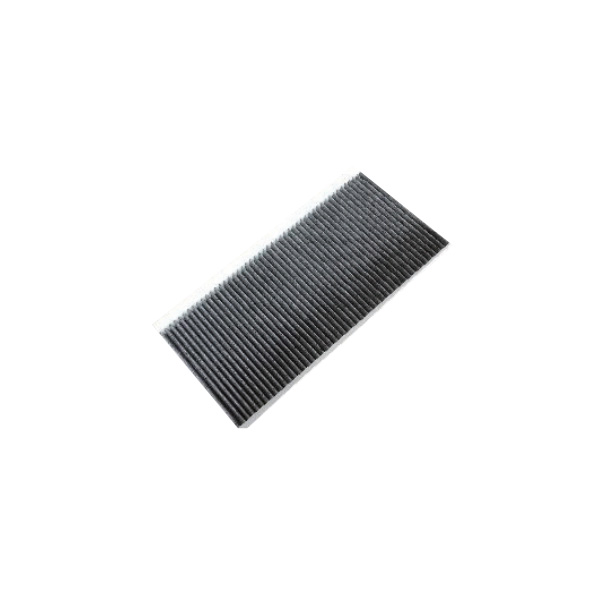
This is a finished automotive cabin air filter from Oltaven, built from a high-efficiency HEPA filter medium combined with high-iodine coconut-shell granular activated carbon. It captures PM2.5 particles and dust from the air entering the cabin and adsorbs ammonia, sulphides and exhaust VOCs, so it is aimed at passenger cars, coaches, heavy trucks and construction machinery used in traffic or dusty environments. The page explains how the medium and the way it is pleated, framed and sealed together decide the filter's efficiency, resistance and dust capacity, and how we turn that into a part that fits a specific vehicle.
Filter media is where performance starts, but it is not where it ends. A roll of HEPA-grade material has a certain particle capture capability and a certain airflow resistance per unit area. Once it is pleated, cut, framed and sealed into a cabin filter, the finished part's efficiency, resistance and dust-holding capacity are set by the combination of those choices. Two filters of the same outer dimensions can behave quite differently because of them.
Pleating is the first lever. More pleats put more medium into the same face area, which lowers the air velocity through each pleat and usually lowers resistance while raising dust capacity. The pleat height and the spacing between pleats must be chosen so air can flow into the channels without the pleats collapsing against each other. The pleating process itself matters too: sharp, even folds keep the channels open, while uneven folds create blocked zones that raise resistance and shorten service life.
Framing and sealing are the second lever. The frame holds the pleat pack at the right dimensions for the vehicle's air duct, and the seal closes the gap between the media pack and the frame. A sound seal keeps unfiltered air from bypassing the medium; a poor one lets dust and odour slip past no matter how good the medium is. In our two-effect construction, the coconut-shell activated carbon is integrated with the HEPA layer, so the forming process also has to preserve the carbon layer's contact with the airflow while keeping the whole pack thin enough for the cabin housing.
Three outcomes matter to a driver and to a vehicle programme: how much particulate is captured, how hard the HVAC fan has to work, and how long the filter lasts before it loads up.
Efficiency comes from the medium grade and from how completely the air is forced through it. A HEPA-grade layer captures PM2.5 particles and dust; the seal and frame make sure the air actually passes through that layer rather than around it.
Resistance is a fluid property of the finished part. The facts for this product describe good airflow characteristics and low operating resistance. That is achieved through pleat geometry and channel openness, not by thinning the medium until it stops filtering.
Capacity and service life come from how much dust the pleat pack can hold before resistance rises too far. High dust capacity is one of the stated characteristics of this filter, and it is the reason a well-formed pleat pack outlasts a flat sheet of the same medium.
Odour and gas control come from the carbon. High-iodine coconut-shell granular activated carbon is chosen for targeted adsorption of ammonia, sulphides and exhaust VOCs, and the way the carbon is held in the pack determines how long that adsorption lasts.
These filters are made for vehicle air-conditioning and ventilation systems: passenger cars including sedans, SUVs and MPVs, commercial coaches, heavy trucks and construction machinery. The same construction logic applies across those vehicles; what changes is the size, thickness and pleat count needed to fit each original air duct.
Because we sell the finished filter rather than the medium alone, the part is built to the vehicle's duct requirements. Dimensions, thickness and pleat count are customisable per vehicle model, which is how one construction can serve a compact car and a coach with very different cabin volumes.
| Item | Detail |
|---|---|
| Product name | Automotive cabin air filter / automotive air filter element |
| Core construction | Dual-effect composite: high-precision HEPA filter medium plus high-iodine coconut-shell granular activated carbon |
| Core purification performance | High-efficiency interception of PM2.5 particles and dust, plus targeted adsorption of ammonia, sulphides and exhaust VOCs |
| Physical and flow characteristics | Good airflow characteristics, low operating resistance, very high dust-holding capacity and long service life |
| Main applications | Air-conditioning and ventilation systems of passenger cars (sedans, SUVs, MPVs), commercial coaches, heavy trucks and construction machinery |
| Size customisation | Full OEM/ODM flexibility across vehicle models; any length, width, thickness and pleat count can be customised to the original vehicle's air-duct requirements |
| Quality system | 50,000 m² plant; IATF 16949 automotive quality management system; factory quality assured by a CNAS-accredited testing centre |
Oltaven supports OEM and ODM cabin filter projects and has developed more than 1,000 filtration solutions over 20-plus years of filter research and manufacturing. That experience is applied to the finished part: media selection, pleating, framing, sealing and packaging.
The production base in Zhongshan, Guangdong, China covers 50,000 m², including six cleanrooms with a combined area of 20,000 m², which helps keep the filter-making process free of secondary contamination. Our in-house laboratory is accredited by CNAS and can issue reports on filtration efficiency, dust-holding capacity and resistance. The company has held IATF 16949 automotive quality management system certification since 2024, and also operates ISO 9001, ISO 14001 and ISO 45001 systems. Products meet REACH and RoHS requirements, and compliance documents can be supplied. Multiple automated production lines give monthly capacity in the millions of pieces, with IQC, IPQC and OQC checks across the process.
To quote a cabin filter project, tell us the device or vehicle model, the size or a drawing, the airflow the system needs, the operating conditions (traffic, dust, odour) and the quantity you expect. Share those details through our contact page and our team will respond with a specification and sample plan.
Resistance in a finished cabin filter comes mainly from how the medium is pleated and how openly air can pass through the channels. More pleats and taller, evenly spaced channels lower the air velocity through each pleat and reduce resistance, while collapsed or uneven pleats raise it. The medium grade also matters, but two filters of identical outer dimensions can still differ once forming is taken into account.
Efficiency depends on the medium grade and on whether all the air actually passes through it. A sound seal between the pleat pack and the frame stops unfiltered air from bypassing the medium, and even pleat spacing keeps the whole face working. A poor seal or blocked channels can let dust and odour past even a high-grade HEPA layer.
Yes. Oltaven supports full OEM/ODM customisation for vehicle models, including any length, width, thickness and pleat count to match the original vehicle's air-duct requirements. We can also customise the structure, filter medium grade, frame material, logo and packaging. The starting point is the vehicle model plus a size or drawing.
Yes. Share the vehicle model, size or drawing, required airflow, operating conditions and expected quantity, and we will prepare a specification and sample plan. Samples are tested in our CNAS laboratory for efficiency, resistance and dust capacity, and you can validate them in the vehicle before committing to production.
Standard models typically start at 500–1,000 pieces, while customised models are agreed separately based on tooling and material needs, usually 2,000–5,000 pieces. Regular products take 15–25 days; customised products including tooling take about 30–45 days for development and 25–35 days for mass production.
Under normal use, we recommend replacing the antibacterial cabin filter every 15,000–20,000 km or once a year. In heavily polluted or dusty areas, shorten this to about 10,000 km. The dust-holding capacity and antibacterial persistence are verified in our CNAS laboratory, and life-test data can be provided for purchasing reference.
It starts with your vehicle model, dimensions or drawing and your performance target. We then select the medium and carbon, define pleat count and frame dimensions, build samples and test them in the CNAS laboratory. After your validation, we finalise branding and packaging and move to production under IQC, IPQC and OQC.
We can supply the IATF 16949 certificate, CNAS test reports, REACH and RoHS compliance documents, antibacterial test reports and MSDS to support customs clearance and local regulations. If you need a specific document set, tell us the destination market when you inquire through our contact page.