
RU-RU
Связаться с нами The Oltaven disc-shaped activated carbon filter cartridge is a finished, food-grade water filter that drops into portable sports bottles and jugs to reduce chlorine, odours, organic matter…
FILTER MEDIA / ROLLS · SHEETS · DIE-CUT
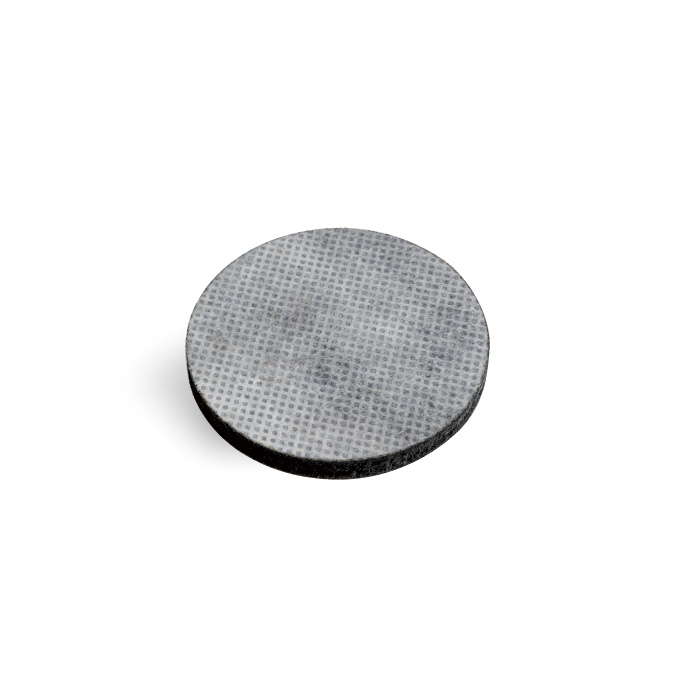
The Oltaven disc-shaped activated carbon filter cartridge is a finished, food-grade water filter that drops into portable sports bottles and jugs to reduce chlorine, odours, organic matter and some heavy metals while keeping beneficial minerals in the water. It is built for outdoor sports, hiking, travel and everyday portable drinking, and it is made and supplied by Oltaven from Zhongshan, Guangdong, China. This page explains how media choice and forming decide the finished filter's efficiency, resistance and capacity, and how we turn that into a cartridge you can put your name on.
A carbon filter is not a bag of charcoal. The finished behaviour of a disc cartridge comes from four decisions made together: which carbon, how it is held, how water is routed through it, and how the outer housing seals. Oltaven sells the finished filter, so we take responsibility for all four.
Media. We use food-grade coconut-shell activated carbon as the core medium. Coconut carbon has a fine pore structure and is well suited to drinking-water applications where taste and chlorine reduction matter. The carbon is matched to the housing by weight, because the amount of carbon sets how much water the cartridge can treat before it is spent.
Holding the media. Loose granules can migrate and shed fines into the drink. The carbon is therefore contained within a food-grade non-woven structure inside an ABS/PP housing. This fixes the media in place, keeps the water path predictable and helps prevent carbon dust reaching the bottle.
Forming the disc. The flat, round shape is chosen for bottles where the filter sits in a narrow neck and water passes through under gravity or light suction. Diameter and thickness are not cosmetic: they set the surface area water crosses and the depth of media it must travel through. A thicker disc gives more contact time and capacity; a thinner one gives lower resistance. The right balance depends on the bottle and how the user drinks.
Sealing and finishing. The housing is joined so that water cannot bypass the carbon. A poor seal lets water take a shortcut and the filter appears to underperform even when the media is good. Assembly and packaging of this cartridge are carried out in cleanroom conditions to avoid re-contamination before the product reaches the user.
Three outcomes matter to a brand: how well the filter removes what it should, how easily water flows through it, and how long it lasts. In practice these trade against each other, and the forming choices above decide where the balance lands.
Because these factors interact, a change to any one of them is verified rather than assumed. Oltaven's laboratory can test flow, chlorine removal and related indicators on semi-finished and finished cartridges, so a specification is confirmed on the actual product, not only on the raw material.
The disc format suits portable drinking products where space is short and the filter is replaced by the user. Typical uses include:
Because the cartridge is a finished component, it can be packed, branded and shipped as a retail item or as an accessory inside a bottle kit. If your device has a different neck, cap or flow path, the disc can be re-dimensioned rather than forced into a shape that does not fit.
| Item | Detail |
|---|---|
| Product name | Sports Water Bottle Activated Carbon Filter Cartridge (Disc Shape) |
| Category | Water jug filter / drinking bottle filter cartridge |
| Brand | Oltaven |
| Core filtration medium | Food-grade coconut-shell activated carbon |
| Media containment and housing | Food-grade non-woven material with ABS/PP housing structure |
| Function | Reduces residual chlorine, odours, organic matter and some heavy metals; retains beneficial minerals |
| Chlorine removal rate | More than 95%, tested at the company's CNAS-accredited laboratory |
| Standard service life | Approximately 100–200 L, about 1–3 months depending on water quality and frequency of use |
| Typical applications | Sports bottles, portable drinking bottles, water jugs, travel drinkware |
| Customisable items | Diameter and thickness, carbon weight and formulation, housing colour and material, logo printing, retail packaging (colour box, vacuum bag, blister), instructions and certification markings |
| Dimensions and ratings | Made to order; confirmed by sample and drawing for each project |
Oltaven has more than 20 years of filtration research and manufacturing experience and has exported to Europe, the United States, Japan and South Korea for over two decades. OEM/ODM work is central to what we do: our teams have developed more than 1,000 filtration solutions, covering size, structure, media grade, housing material, logo and packaging.
The production base in Zhongshan, Guangdong, China, covers 50,000 m², including six cleanrooms totalling 20,000 m² where cartridges are assembled and packed. Our in-house laboratory is accredited by CNAS and can issue test reports on filtration efficiency, dust holding capacity and resistance, which supports customers preparing their own market documentation.
Our management systems are certified to ISO 9001, ISO 14001 and ISO 45001, and we gained IATF 16949 automotive quality certification in 2024. Products meet REACH and RoHS requirements and compliance documents can be supplied. Quality control runs through IQC, IPQC and OQC, and multiple automated lines support monthly output in the millions of pieces.
If you are developing a bottle, jug or drinkware line and want a filter that matches it, we would like to work with you. To quote accurately, please send your device or bottle model, the required size or a drawing, the target water flow, the operating conditions (water source, temperature, gravity or pumped flow), and your estimated quantity. If you already have packaging or branding requirements, include those too.
Send your details through our contact page and our team will respond with a proposal and sample plan.
Resistance comes from how water travels through the media, not from outer dimensions alone. Two cartridges of the same diameter can differ in carbon weight, media thickness and how evenly water spreads across the disc. Oltaven tunes these factors to the bottle and the way it is used, so flow and contact time match the application.
It starts with your device or bottle model, the available space, target flow and market water quality. We then propose carbon type and weight, disc dimensions, housing and packaging, and produce samples for evaluation. After sample and drawing approval, tooling, pilot run and mass production follow.
Testing at Oltaven's CNAS-accredited laboratory shows a chlorine removal rate of more than 95% for this disc-shaped activated carbon cartridge. Actual performance in service depends on water quality, flow rate and how long the cartridge has been in use.
Yes. Diameter, thickness, carbon weight and formulation can be adjusted for your bottle, along with housing colour and material, logo printing and retail packaging. Because dimensions are made to order, each project is confirmed by sample and drawing rather than by a fixed catalogue size.
The standard cartridge is rated for approximately 100–200 L, or about 1–3 months depending on water quality and frequency of use. For a private-label product we can adjust carbon weight and formulation so the replacement interval fits your packaging and retail plan.
MOQ is usually 1,000–2,000 pieces depending on specification and packaging, with 5,000 pieces suggested for custom models. Standard items ship in 7–15 days and custom orders typically take 25–35 days. Standard samples can be provided free of charge with freight paid by the customer; custom samples carry a development fee that is offset against a bulk order.
Oltaven holds ISO 9001, ISO 14001 and ISO 45001 certification and gained IATF 16949 certification in 2024. Products meet REACH and RoHS requirements and compliance documents can be provided. The cartridge uses food-grade coconut-shell carbon and food-grade non-woven material with an ABS/PP housing.
Yes. Our CNAS-accredited laboratory can test flow, chlorine removal and related indicators on semi-finished and finished cartridges and issue reports. This data can support the preliminary testing you need before pursuing certification in your target market. Contact us through the <a href="/en/contact">contact page</a> to discuss your project.