
HI-IN
संपर्क करें The Oltaven aluminum pre-filter is a washable, all-metal panel filter built from layers of corrugated expanded aluminum or stainless steel mesh held in an aluminum, stainless steel or ABS…
FILTER MEDIA / ROLLS · SHEETS · DIE-CUT
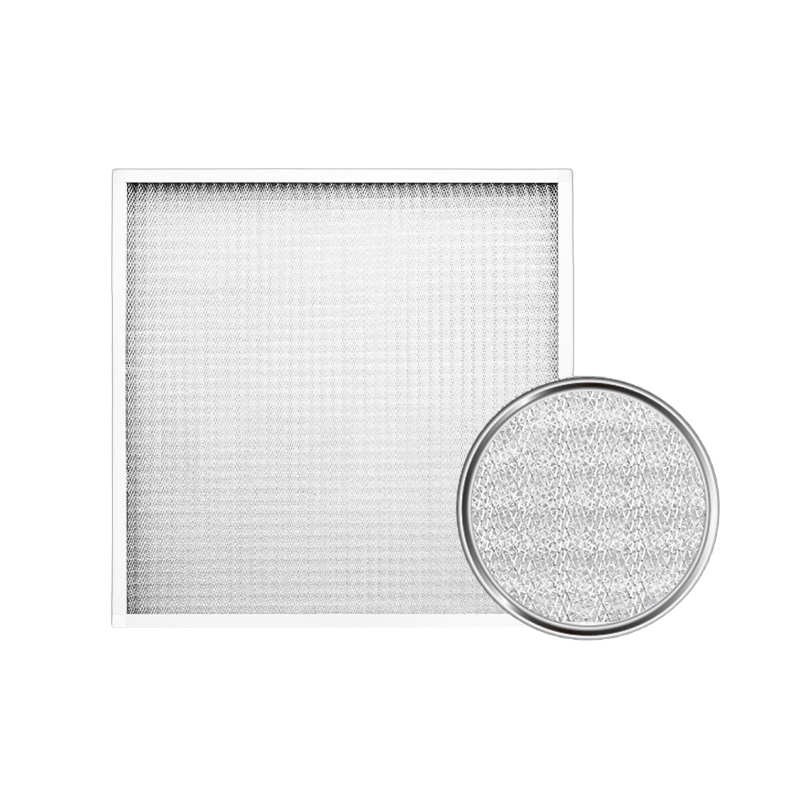
The Oltaven aluminum pre-filter is a washable, all-metal panel filter built from layers of corrugated expanded aluminum or stainless steel mesh held in an aluminum, stainless steel or ABS frame. It captures coarse airborne debris — dust above roughly 5 μm, hair, lint, fibres and leaves — ahead of finer filtration stages in commercial air handling and ventilation systems. It suits facility engineers, HVAC OEMs and industrial operators working in humid, hot or corrosive exhaust environments who want a reusable first stage rather than a disposable one. Oltaven sells the finished filter, with the media, pleating and framing already matched to the duty.
A filter is often described by its media, but the media alone does not set what the installed panel will do. The same expanded aluminum mesh can leave a factory as a loose roll or as a rigid cassette, and the two behave very differently in a duct. Forming is what turns one into the other.
In a metal pre-filter, the mesh is expanded and then corrugated into waves. Those waves are stacked in layers, and the layer count is a design variable rather than a fixed feature. More layers give the air more surface to pass over and more pockets to drop debris into, which raises holding capacity; fewer layers keep the panel light and open. The stack is then bonded into a frame, and the frame holds the layers at a fixed spacing so the wave pattern does not collapse under airflow or during washing.
This is why Oltaven describes itself as a maker of finished filters. The interesting engineering is not only which alloy goes into the mesh, but how many corrugated layers are used, how the edges are closed, and which frame material suits the installation. A panel destined for a coastal cooling tower intake and a panel destined for a paint booth pre-stage may share a mesh type and still be built quite differently.
Resistance and dust holding capacity pull in opposite directions. A denser stack — more corrugated layers — traps more coarse material before it reaches the next stage, but it also asks the fan for more static pressure. A lighter stack keeps initial resistance low and is easier to wash clean, but it loads up sooner. Because Oltaven builds to order, the layer count can be selected for the application: a low-resistance open stack for a large central air handling unit, a deeper stack where the incoming air is heavily loaded with lint or oil smoke.
The frame is not cosmetic. Aluminum profile frames are light and corrosion-resistant, which suits humid air handling rooms and general ventilation. Stainless steel frames are chosen where the air stream is aggressive or where repeated high-pressure washing is expected. ABS plastic frames offer a non-metallic option for certain commercial installations. Each choice changes weight, wash behaviour and the way the panel sits in its holding frame.
Air takes the easiest path. If the perimeter of the media stack is not closed against the frame, air slips around the layers instead of through them, and the nominal efficiency of the mesh means little. Edge closure is therefore part of the finished product, not an afterthought, and it is one of the details that separates a serviceable pre-filter from a loose mesh insert.
The all-metal build is what makes the panel reusable. It is fire-retardant, resistant to acid and alkali attack, and tolerant of high temperatures and high humidity — conditions that shorten the life of disposable fibrous panels. The panel can be cleaned with circulating water and returned to service, which lowers long-run operating cost in plants that would otherwise replace pre-filters frequently.
In each case the panel is doing the same job — taking the coarse load early, where it is easy to remove and wash away.
| Item | Detail |
|---|---|
| Product name | Aluminum Pre-Filter (metal mesh filter) |
| Core filtration material | Multi-layer corrugated expanded aluminum mesh or stainless steel mesh; layer count customisable |
| Frame material | Aluminum profile frame, stainless steel frame, or ABS plastic frame |
| Physical properties | Low initial resistance, fire-retardant, acid and alkali resistant, repeatedly washable |
| Typical applications | Humid and high-temperature industrial exhaust; pre-filtration in commercial central air conditioning; insect and leaf pre-filtration for plant rooms; ventilation in acid and alkali workshops |
| Common standard depths | 1 inch (21 mm) / 2 inch (46 mm) |
| Reference sizes (W × H × D) | 12×24×1 in (287 × 592 × 21 mm); 24×24×1 in (592 × 592 × 21 mm); 12×24×2 in (287 × 592 × 46 mm); 24×24×2 in (592 × 592 × 46 mm) |
| OEM/ODM customisation | Any length, width, thickness and metal mesh layer count can be built to order; Oltaven operates a 50,000 m² plant and holds ISO and IATF 16949 certification |
Oltaven has spent more than 20 years developing and manufacturing filtration products, and OEM/ODM work is central to that experience: the company has developed more than 1,000 filtration solutions across its product range. The production base covers 50,000 m² in Zhongshan, Guangdong, China, including six cleanrooms with a combined area of 20,000 m². Quality testing is supported by an in-house laboratory accredited by CNAS, which issues reports on filtration efficiency, dust holding capacity and resistance. The company holds IATF 16949, the automotive quality management system standard, together with ISO 9001, ISO 14001 and ISO 45001. Products meet REACH and RoHS requirements, and compliance documentation can be supplied. Finished filters have been exported to Europe, the United States, Japan and Korea for over 20 years.
To quote accurately, Oltaven needs five things: the device or system model, the size you need or a drawing, the airflow or water flow the filter will see, the operating conditions, and the quantity you expect per order. With those details the team can recommend a layer count and frame material and confirm which of the reference sizes fits or whether a custom panel is required. Contact Oltaven to open a project.
Size fixes the face area, but resistance depends on how much mesh the air must pass through. A stack with more corrugated layers, or a finer mesh, presents more surface and tighter passages, so initial resistance rises. Two panels measuring 592 × 592 × 46 mm can therefore behave differently, which is why Oltaven treats layer count as a design choice rather than a fixed specification.
The aluminum pre-filter is a coarse-stage filter, typically rated G2–G4 under EN 779 or MERV 1–8 under ASHRAE 52.2, and it intercepts particles above roughly 5 μm along with hair, fibres and leaves. It is used in commercial central air conditioning, fresh-air units, cooling tower intakes, industrial exhaust in humid or hot areas, and as a protective pre-stage ahead of finer filters.
Yes. Oltaven builds to order on length, width, thickness and metal mesh layer count, and offers aluminum profile, stainless steel or ABS frames. Send a drawing or sample and the team will confirm which combination suits the installation and the air stream conditions.
Share the device or system model, the required size or drawing, the airflow, the operating conditions and the expected quantity. Oltaven will propose a build, quote against it, and supply a sample for fit and performance checks; efficiency, resistance and dust holding capacity can be measured in the CNAS-accredited laboratory.
MOQ depends on the specification: standard sizes and custom builds are quoted individually once dimensions, frame material and layer count are confirmed. Because Oltaven runs multiple production lines in a 50,000 m² plant, order volume can be matched to the project rather than forced into a single fixed quantity.
Lead time depends on the order quantity and how far the specification departs from the reference sizes. Standard reference panels move faster than fully custom builds, and Oltaven confirms the schedule in the quotation once the size, layer count and frame material are fixed.
Because the panel is all-metal, it is cleaned with circulating water and returned to service rather than replaced. Cleaning interval depends on how heavily the air stream is loaded — oil smoke and lint service needs more frequent washing than a clean commercial air handling room. Inspect on a schedule set by the site and wash when the panel visibly loads.
Yes. The pre-filter is one stage in a wider programme, and Oltaven has developed more than 1,000 filtration solutions across its range, so a single supply chain can cover coarse protection and downstream stages. <a href="/en/contact">Contact Oltaven</a> to discuss the full filter train.