
EN
Contact A washable primary efficiency filter is a reusable pre-filter built from PET (polyester) media held in a rigid aluminium frame, rated G3, G4 or M5 for capturing coarse dust, hair, fibres…
FILTER MEDIA / ROLLS · SHEETS · DIE-CUT
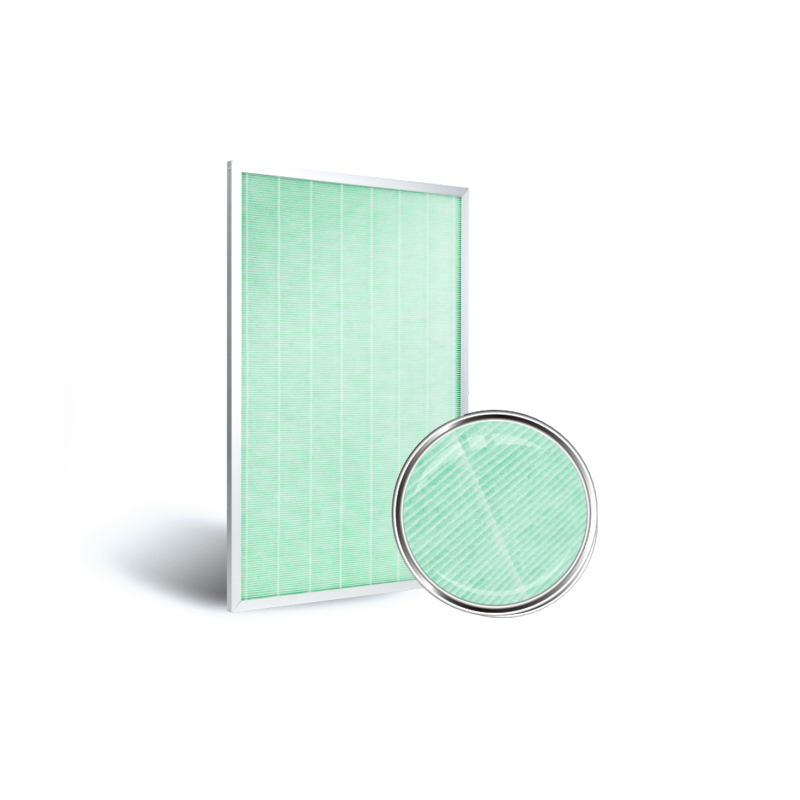
A washable primary efficiency filter is a reusable pre-filter built from PET (polyester) media held in a rigid aluminium frame, rated G3, G4 or M5 for capturing coarse dust, hair, fibres and insects before air reaches the main equipment. Oltaven manufactures the finished filter, not just the media, so the pleating, framing and assembly that determine efficiency, resistance and dust capacity are all controlled in-house. It is designed for commercial HVAC systems, fresh-air handling units, industrial workshops and pre-filter stages ahead of higher-efficiency filters.
Filter media is the starting point, but it is not the product. A roll of high-throughput PET mesh only becomes a filter once it is cut, tensioned, formed and mounted in a frame. Each of these steps changes how the finished unit behaves in an air stream.
Forming decides how much media surface actually meets the air. Media held flat in a frame presents a small face area and clogs quickly; media that is formed and supported across the frame exposes more surface, spreads dust over a wider area and holds resistance lower for longer. The frame decides whether that surface stays in shape under pressure. A weak frame flexes, opens gaps at the edges and lets air bypass the media, which shows up as poor efficiency even when the media itself is capable.
Assembly decides repeatability. Consistent tension, clean cut edges and a square frame mean every unit in a batch performs the same way. This is the practical reason two filters can share a media grade and still behave differently in service.
Oltaven uses a high-throughput, wear-resistant PET (polyester fibre) filter mesh. PET tolerates repeated washing without the fibre structure breaking down, which is what makes a washable filter viable over multiple service cycles. The same media family covers G3, G4 and M5 grades, so the grade you specify is matched to the particle range you need to capture rather than to a single fixed material.
How the media is formed sets the balance between resistance and dust capacity. More effective media area in the same frame means lower face velocity through the media, lower initial resistance and more room for dust before the pressure drop rises. Because Oltaven forms the media in-house, this balance can be tuned to the airflow of a specific installation instead of being fixed by a catalogue size.
The frame is a high-strength aluminium profile, chosen for corrosion resistance and pressure stability. A rigid, square aluminium frame holds its shape at the rated operating velocity, keeps the media under even tension and resists the distortion that causes air bypass. This is why the frame is not a packaging detail: it is part of the filtration performance.
Oltaven rates this filter at an operating face velocity of 2.5 m/s, a level suited to high-airflow industrial fresh-air systems. Running a filter beyond the velocity it was formed and framed for raises resistance and can disturb the media, so the rating should be treated as part of the specification.
As a pre-filter, this product is used where large volumes of air carry coarse contamination and where the cost of disposable filters adds up.
| Item | Detail |
|---|---|
| Product name | Washable primary / medium efficiency air filter |
| Efficiency grade | G3 / G4 / M5, matched to primary and medium pre-filtration duty |
| Media | High-throughput, wear-resistant PET (polyester fibre) filter mesh |
| Frame | Corrosion-resistant aluminium frame |
| Rated operating velocity | 2.5 m/s, optimised for high-airflow industrial fresh-air systems |
| Main applications | Industrial plant HVAC systems, high-humidity exhaust environments, heavy-dust workshop pre-filtration, commercial building central air intakes |
| Standard sizes (W × H × D) | 12×24×2 in (289 × 594 × 46 mm); 16×20×2 in (390 × 492 × 46 mm); 20×20×2 in (492 × 492 × 46 mm); 20×24×2 in (492 × 594 × 46 mm); 24×24×2 in (594 × 594 × 46 mm) |
| Customisation (OEM/ODM) | Non-standard sizes, thicknesses and efficiency grades; supported by a 50,000 m² plant and a CNAS-accredited laboratory; ISO and IATF 16949 certified |
Oltaven is set up for OEM/ODM work rather than catalogue-only supply. More than 20 years of filter development and manufacturing has produced a library of over 1,000 developed filtration solutions, which shortens the path from a drawing or sample to a finished filter.
Production runs in a 50,000 m² plant in Zhongshan, Guangdong, China, including six cleanrooms with a combined area of 20,000 m². Our own laboratory is accredited by CNAS (China National Accreditation Service for Conformity Assessment) and can issue test reports covering filtration efficiency, dust holding capacity and resistance.
Quality management covers ISO 9001, ISO 14001 and ISO 45001, and in 2024 we added IATF 16949 certification for the automotive sector. Products meet REACH and RoHS requirements and compliant documentation can be supplied. We have exported to Europe, the United States, Japan and Korea for more than 20 years, with multiple automated production lines and monthly capacity in the millions of pieces.
To quote accurately and quickly, please tell us the device or vehicle model, the size or a drawing, the required airflow or water flow, the operating conditions (temperature, humidity, dust load) and the quantity you expect. If you already have a media grade or pressure-drop target, include it. Send the details through our contact page and our team will respond with a specification and a proposal.
We see each enquiry as the start of a supply partnership: a filter specified around your equipment, produced under a documented quality system, and supported by test data you can rely on.
Resistance depends on how much effective media area is presented to the air and how evenly the media is formed and framed. Two filters can share a footprint but differ in media area, tension and frame rigidity, which changes face velocity through the media and therefore pressure drop. Oltaven controls forming and framing in-house so resistance matches the rated 2.5 m/s operating velocity.
It starts with your requirement: device or application, size or drawing, airflow and operating conditions. We then select PET media and the G3, G4 or M5 grade, define the aluminium frame and forming for your dimensions, and produce a sample for evaluation. Oltaven has developed over 1,000 filtration solutions, so the starting point is usually close to an existing design.
The media sets the particle range the filter can capture and how much dust it can hold before resistance rises. PET mesh is wear-resistant and tolerates repeated washing, which supports a reusable filter. The finished grade—G3, G4 or M5—is matched to the duty, and the forming and framing determine how much of that media capability is actually used.
Yes. Oltaven supports non-standard sizes, thicknesses and G3, G4 or M5 efficiency grades, with aluminium frames and options for logo and packaging. Custom work is backed by our 50,000 m² plant and CNAS-accredited laboratory. Share a drawing or sample and we will confirm feasibility.
Yes. Send the application, size or drawing, airflow and operating conditions, and we will provide a specification and quotation. A sample can be produced for fit and performance evaluation before volume production, so you can verify resistance, efficiency and build quality against your own requirements.
MOQ and lead time are confirmed per project after we review your size, grade and quantity, because custom forming and framing affect the production plan. Oltaven runs multiple automated production lines with monthly capacity in the millions of pieces, which supports both initial orders and repeat supply. Contact us with your forecast for a firm schedule.
A washable PET filter is designed for repeated cleaning, but media and frame eventually degrade with wash cycles and dust load. Replace it when cleaning no longer restores resistance to its expected level, or when the media or aluminium frame shows damage. Monitoring pressure drop across the filter is the practical guide to both cleaning and replacement timing.
Use our <a href="/en/contact">contact page</a> and include the device or vehicle model, size or drawing, airflow or water flow, operating conditions and quantity. That information lets us propose the right media, grade and frame without back-and-forth. We will reply with a specification and quotation for your review.