
EN
Contact This is a sintered activated carbon block filter, supplied as a finished cartridge in the Ф51×127 mm format, made by Oltaven from high-iodine-value coconut shell carbon with food-grade ion…
FILTER MEDIA / ROLLS · SHEETS · DIE-CUT
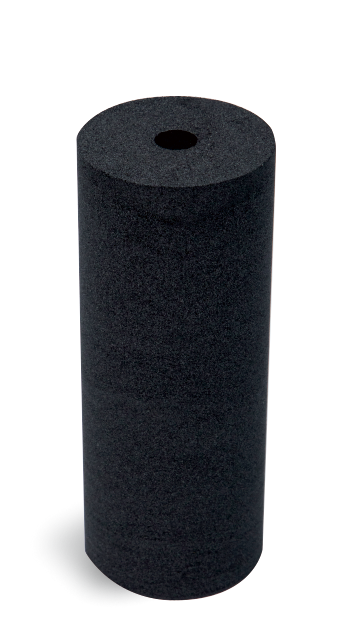
This is a sintered activated carbon block filter, supplied as a finished cartridge in the Ф51×127 mm format, made by Oltaven from high-iodine-value coconut shell carbon with food-grade ion exchange resin built in. It filters drinking water at the point of use: chlorine and its bleaching-powder taste and odour, colour, organic pollutants such as VOCs, and heavy metals including lead and mercury, while the resin helps soften the water and limit scale. It is made for appliance and water-treatment OEMs and brands that fit CTO or T33-style cartridges into reverse-osmosis purifiers, water dispensers, refrigerator water systems and commercial coffee machines.
A carbon block is often described by its raw material, but the powder is only the starting point. What a user experiences at the tap — how fast water flows, how long the taste stays clean, whether fine black particles appear in the glass — is decided by how that powder is formed into a solid cartridge. Oltaven sells the finished filter, not the media, so the forming steps are where the product is actually made.
Sintering binds coconut shell carbon particles together into a rigid, porous block without a loose granular fill. The block holds a uniform microporous structure, so water is forced through the carbon wall rather than channelling around it. That structure gives a high initial flow and a defined filtration rating, and it keeps the carbon from migrating downstream — the reason a well-formed block does not shed black powder into the water.
Pleating and framing, where a pleated design is used, set the surface area that meets the water and the geometry that fits the housing. Sealing and end-cap construction close the block to the housing so water cannot bypass the carbon. Each of these decisions trades off against the others, and the finished cartridge is the balance the application needs.
High-iodine-value coconut shell carbon offers a large adsorption capacity for chlorine, taste and odour, and organic compounds. Adding food-grade ion exchange resin inside the same cartridge extends the job to softening and heavy-metal reduction, so one cartridge handles taste and scale together. Media grade and the carbon-to-resin ratio shift capacity and service life.
The sintered block's wall thickness and pore structure set the resistance water meets and the contact time it gets with the carbon. A denser, finer structure can raise filtration precision but also raises pressure drop; a more open structure protects flow but shortens the adsorption path. Because the block is formed as one piece, the microporous structure stays even along its length, which supports a high initial flow and a long service life.
Outer diameter, inner diameter and length decide how the cartridge seats in its housing, and end-cap welding or sealing closes the flow path. A cartridge that is dimensionally right but poorly sealed lets water slip past the media, and measured efficiency falls even though the carbon is good. Oltaven supports custom end caps and sealing arrangements, so the finished part matches the device rather than being adapted to it.
In each case the same principle applies: the cartridge is selected for the housing it fits and the water it will treat, not for the carbon alone.
| Item | Detail |
|---|---|
| Product name | Carbon block water filter / CTO filter for water purifiers and refrigerators |
| Core filtration media | High-iodine-value coconut shell carbon with food-grade ion exchange resin |
| Core performance | Softens water and limits scale; adsorbs chlorine (bleaching powder) and odours; reduces colour and off-taste; captures harmful heavy metals such as lead and mercury |
| Precision and service life | Uniform microporous structure, high initial flow, high filtration precision with no black powder shedding; large saturated adsorption capacity and long service life |
| Reference standard sizes (OD × length, mm) | Ф60×130 / Ф62×240 / Ф37.5×75 / Ф38×57 / Ф40×195 / Ф51×127 / Ф32×126 / Ф32×106 |
| Main end uses | Household RO purifiers (CTO pre-filter / T33 post-filter), direct-drinking dispensers, French-door refrigerator water filters, commercial coffee machines |
| Customisation | Full OEM/ODM support; length, diameter and inner/outer diameter ratios tooled to the device, with custom end-cap welding |
| Quality systems | ISO 9001 and IATF 16949 certified production; filter media meet drinking-water safety and hygiene standards; CNAS-accredited testing centre for quality control |
Oltaven's OEM/ODM capability is the foundation of this product. Over more than 20 years we have developed more than 1,000 filtration solutions for customers, and custom work on this carbon block — dimensions, end caps, media grade, logo and packaging — follows that same development route rather than starting from scratch.
Production runs in a 50,000 m² plant in Zhongshan, Guangdong, China. Six cleanrooms totalling 20,000 m² keep cartridges free of secondary contamination during production and assembly, and automated lines support output of millions of pieces per month.
Quality is controlled through IQC, IPQC and OQC stages, backed by a CNAS-accredited laboratory that can issue reports on filtration efficiency, dust-holding capacity and resistance. The plant holds ISO 9001, ISO 14001 and ISO 45001 certification and gained IATF 16949 in 2024. Products meet REACH and RoHS requirements, with compliance documents available on request.
To quote accurately, tell us the device or vehicle model the cartridge fits, the size or a drawing, the required airflow or water flow, the operating conditions (inlet water quality, pressure, temperature) and your estimated quantity. With those details we can propose a specification, sample plan and production schedule. Contact Oltaven to begin.
Resistance comes from the formed structure, not the outer dimensions alone. Two Ф51×127 cartridges can have different wall thickness, pore structure and carbon density, and a denser structure raises pressure drop while a more open one protects flow. Sealing also matters, because a tight seal forces water through the carbon instead of letting it bypass.
Efficiency is set by the media grade and the forming. High-iodine-value coconut shell carbon provides the adsorption capacity for chlorine, taste, odour and VOCs, and the sintered microporous structure keeps contact uniform along the block. Filtration precision and end-cap sealing then determine how much of the water actually passes through the media.
Yes. The standard range covers outer diameters from Ф30 to Ф60, and OEM/ODM work covers length, diameter and inner/outer diameter ratios tooled to your device, with custom end-cap welding. The reference sizes (Ф60×130, Ф62×240, Ф37.5×75, Ф38×57, Ф40×195, Ф51×127, Ф32×126, Ф32×106 mm) show the formats we already run.
It starts with your requirement: device model, size or drawing, target water flow, operating conditions and quantity. We then propose a specification covering media grade, resin content, dimensions and end caps, produce samples for your evaluation, and lock the specification before tooling and mass production.
Yes. Samples are produced for bench or field testing before tooling and volume commitments are fixed, and the quote follows the agreed specification, packaging and quantity. Share your drawing or housing dimensions and we will set up the sample plan.
Order quantities and lead times for this carbon block are set per project, based on the specification, tooling status and packaging; please confirm them with our team when you request your quote. The Zhongshan plant runs multiple automated lines with monthly output of millions of pieces, which supports scheduled repeat orders.
Replacement depends on inlet water quality and daily volume, because chlorine load and turbidity consume adsorption capacity faster. Monitor taste, odour, flow and scale, and set the change interval from your own test data rather than a single fixed figure. We can advise on a monitoring plan for your device.
Send the device model, housing dimensions or a drawing, required flow and operating conditions, and we will confirm the fit and propose the media grade and sealing arrangement. <a href="/en/contact">Contact Oltaven</a> with those details to start the evaluation.