
EN
Contact The Oltaven Ф40×195 sintered activated carbon stick is a solid carbon block filter made from high-iodine-value coconut shell carbon with an integrated food-grade ion exchange resin layer,…
FILTER MEDIA / ROLLS · SHEETS · DIE-CUT
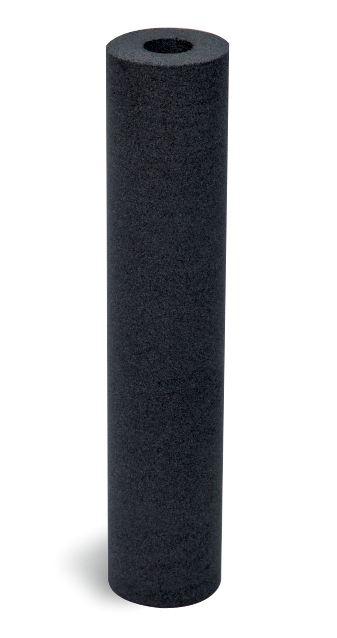
The Oltaven Ф40×195 sintered activated carbon stick is a solid carbon block filter made from high-iodine-value coconut shell carbon with an integrated food-grade ion exchange resin layer, formed by sintering rather than glued compression. It reduces chlorine and chloramine taste and odour, removes discolouration and odour, softens water to limit scale, and captures harmful heavy metals such as lead and mercury. It is built for appliance and water-treatment brands that fit cartridges inside household reverse osmosis purifiers, direct-drinking dispensers, side-by-side refrigerator water systems and commercial coffee machines.
Carbon is sold in many forms — loose granules, powdered carbon, carbon-impregnated nonwovens, compressed blocks and sintered sticks. Each behaves differently once water passes through it. A sintered stick is the result of taking carbon particles of a chosen mesh, blending them with a small amount of binder, shaping the mix into a hollow or solid cylinder and heating it until the particles fuse into a rigid, porous body.
That forming step is what turns media into a product. The carbon's iodine value, particle size distribution and the resin loading set the ceiling for adsorption capacity. The sintering temperature, pressure and dwell time decide how tightly the particles bond, which fixes the pore network that water must travel through. The finished stick therefore has a structure that media alone cannot deliver: uniform micro-pores, a stable pressure drop as flow rises, and enough mechanical strength to resist cracking under line pressure. Oltaven sells this finished filter, not the raw carbon, because the performance a customer measures at the tap is decided at forming.
High-iodine coconut shell carbon gives a large internal surface area for chlorine, volatile organic compounds and taste-and-odour molecules. Blending in food-grade ion exchange resin adds a softening function and heavy-metal capture inside the same cartridge, so one stick performs two jobs.
Finer carbon particles create a denser pore network: better interception of fine particles and no black carbon fines escaping downstream, but a higher initial resistance. Coarser particles keep initial flow high at the cost of some fine-particle capture. The balance is chosen per application, which is why sticks of identical outer dimensions can behave differently.
The end caps and the way the block is joined to them determine whether water actually passes through the carbon or slips around it. Oltaven supports end-cap welding and custom end-cap structures to match the interface of a specific purifier, refrigerator or coffee machine. A well-formed joint keeps the full flow inside the media and prevents bypass.
Outer diameter and length set the media volume and therefore the capacity and service life. The Ф40×195 format is one reference size in a family that also includes Ф60×130, Ф62×240, Ф37.5×75, Ф38×57, Ф51×127, Ф32×126 and Ф32×106. Diameters from Ф30 to Ф60 can be tailored, and length, wall proportion and end-cap design follow the host device.
Household reverse osmosis purifiers use sintered carbon sticks as the CTO stage ahead of the membrane, protecting the RO element from chlorine, and as a T33-style post-filter for final taste polishing. Direct-drinking dispensers and water coolers use the same construction where a compact, high-capacity cartridge is needed. Side-by-side refrigerators with built-in water dispensers accept slim sticks sized to the internal housing. Commercial coffee machines use carbon filtration to remove chlorine and odour that would otherwise affect extraction and machine scale.
Because the stick holds its shape and does not release carbon fines, it suits tight hydraulic circuits and appliances where a loose carbon bed would migrate. The integrated resin is useful where incoming water is hard and scale on heating elements or membranes is a concern.
| Item | Detail |
|---|---|
| Product name | Carbon block water filter / CTO filter for water purifiers and refrigerators |
| Core filtration media | High-iodine coconut shell activated carbon with food-grade ion exchange resin |
| Core performance | Softens water and limits scaling; strongly adsorbs residual chlorine (bleaching powder); removes abnormal colour and odour; captures harmful heavy metals such as lead and mercury |
| Precision and service life | Uniform micro-pore structure, high initial flow, fine filtration precision with no black carbon fines; large saturated adsorption capacity and long service life |
| Reference sizes (outer diameter × length, mm) | Ф60×130 / Ф62×240 / Ф37.5×75 / Ф38×57 / Ф40×195 / Ф51×127 / Ф32×126 / Ф32×106 |
| Main end uses | Household reverse osmosis purifiers (CTO pre-filter / T33 post-filter), direct-drinking dispensers, side-by-side refrigerator water filters, commercial coffee machines |
| Customisation | Full OEM/ODM support: length, diameter, inner/outer diameter ratio and end-cap welding can be tooled to the device; diameters from Ф30 to Ф60 offered flexibly |
| Quality systems | ISO 9001 and IATF 16949 certified manufacturing; filter media meet potable-water hygiene standards, backed by a CNAS-recognised testing laboratory |
Oltaven supports OEM and ODM programmes and has developed more than 1,000 filtration solutions across two decades of research and manufacturing. Production runs in a 50,000 m² plant in Zhongshan, Guangdong, China, which includes six cleanrooms totalling 20,000 m². A CNAS-recognised laboratory issues test reports on filtration efficiency, dust holding capacity and resistance, so a customer's specification can be checked against measured data rather than assumed.
The plant holds IATF 16949, awarded in 2024, alongside ISO 9001, ISO 14001 and ISO 45001. Products comply with REACH and RoHS, and compliance documents are available. Quality control follows incoming, in-process and outgoing inspection stages. Oltaven has exported to Europe, the United States, Japan and Korea for more than 20 years.
To quote accurately, tell us the purifier, dispenser, refrigerator or coffee machine model, the cartridge size or a drawing, the water flow or flow rate you need, the operating pressure and water quality, and your order quantity. Send these details through the contact page and our team will respond with a specification proposal.
Resistance depends on the pore network formed during sintering, which is set by carbon particle size, binder ratio and sintering conditions. A finer carbon gives tighter pores and finer interception but higher resistance, while coarser carbon keeps initial flow high. Two sticks measuring Ф40×195 can therefore show different pressure drop even though they look identical from outside.
Forming fuses the carbon particles into a rigid porous body with uniform micro-pores and enough strength to hold under line pressure. It also fixes the end-cap joint, so water is forced through the media instead of bypassing it. The result is stable flow, fine filtration precision and no black carbon fines downstream.
Yes. Oltaven supports OEM/ODM work covering length, diameter, inner/outer diameter ratio and end-cap welding, with diameters from Ф30 to Ф60 offered flexibly. The Ф40×195 format is only one reference size in a wider family that includes Ф60×130, Ф62×240, Ф37.5×75 and others. Send a drawing or the device model and the engineering team will design to the housing.
Provide the device model, cartridge size or drawing, required water flow, operating conditions and order quantity through the contact page. The team will propose a specification, produce samples and test them in the CNAS-recognised laboratory. The quotation follows the approved specification and packaging.
Minimum order quantities are set per product and packaging requirement, so they are confirmed at quotation rather than fixed in advance. Because Oltaven runs its own plant in Zhongshan with automated lines, volumes can be planned around your programme. Ask for the MOQ for your specific size and end-cap design.
Lead time depends on whether the item is an existing reference size or a new tooled design, and on packaging. The workflow includes specification review, sample production and laboratory testing, customer validation and then production. Your confirmed schedule is given with the quotation so it can be planned into your supply chain.
Replacement depends on water quality, flow and the volume of water treated, because service life is set by the saturated adsorption capacity of the media. The stick is designed with a large saturated capacity and long service life, but the change interval should be set from your own water testing. Confirm the interval during sample validation.
The plant holds IATF 16949, awarded in 2024, plus ISO 9001, ISO 14001 and ISO 45001, and products comply with REACH and RoHS with documents available. Filter media meet potable-water hygiene standards, and a CNAS-recognised laboratory issues test reports. Share your target market requirements through the <a href="/en/contact">contact page</a> to discuss what documentation fits your programme.