EN
Contact This is a sintered activated carbon rod filter with a nominal outer diameter of 38 mm and length of 57 mm, made by Oltaven. It filters chlorine, odours, colour and heavy metals such as lead…
FILTER MEDIA / ROLLS · SHEETS · DIE-CUT
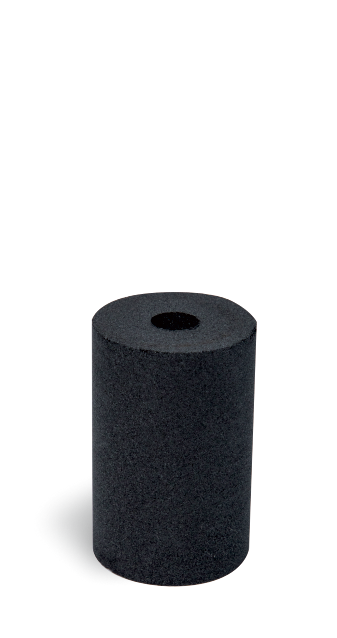
This is a sintered activated carbon rod filter with a nominal outer diameter of 38 mm and length of 57 mm, made by Oltaven. It filters chlorine, odours, colour and heavy metals such as lead and mercury from drinking water, and includes food-grade ion exchange resin for scale reduction. It is designed for domestic reverse osmosis systems, water dispensers, refrigerators and commercial coffee machines, and can be customised in size and end-cap design for OEM projects.
A filter's performance is set by two things: the media inside it and the way that media is formed into a finished part. The carbon rod starts with high-iodine coconut shell activated carbon, chosen for its fine pore structure and strong adsorption of chlorine and organic compounds. Food-grade ion exchange resin is added to soften water and help capture heavy metals. These powders are then sintered — heated under pressure without melting — into a rigid, porous rod. The sintering step locks the particles together so the rod holds its shape and does not shed black powder into the water. Pleating, framing and sealing are not part of this rod's construction; instead, the rod is a solid block with end caps that can be welded to suit the housing. Oltaven sells the finished filter, not just the media, so the forming process is controlled in-house from start to finish.
Three factors determine how a finished carbon rod behaves in service: the media, the forming and the sealing.
Media choice sets the adsorption capacity. Coconut shell carbon with a high iodine number offers more surface area and a higher capacity for chlorine and taste-and-odour compounds. Adding ion exchange resin extends the filter's function to scale reduction and heavy-metal capture. The ratio of carbon to resin is adjusted to balance flow and capacity.
Forming controls resistance and filtration accuracy. The sintering temperature and pressure determine the pore size and the strength of the rod. A tighter pore structure gives higher filtration accuracy and longer contact time, which improves chlorine removal, but it also raises pressure drop. Oltaven tunes the process so that the rod has uniform micropores, high initial flow and high filtration accuracy without loose carbon fines. The result is a filter that removes more than 90% of residual chlorine while keeping resistance within the range expected by the appliance.
Sealing and end caps ensure that water passes through the carbon rather than bypassing it. End caps can be customised with different connection types, and the seal between the cap and the rod is critical to avoid leakage or bypass. Oltaven offers end-cap welding to match the housing design, so the finished filter fits the device correctly and performs as specified.
Because these three factors interact, two filters of the same size can perform differently. A filter made with lower-grade carbon or a looser bind will have lower resistance but shorter life and lower chlorine removal. Oltaven's process control aims to deliver a consistent balance: high adsorption capacity, long service life and no carbon fines.
The Ф38×57 carbon rod is commonly used as a pre-filter (CTO) or post-filter (T33) in household reverse osmosis systems, where it protects the RO membrane from chlorine and improves taste. It is also used in point-of-use water dispensers, double-door refrigerators with built-in water filters, and commercial coffee machines where consistent water quality affects beverage taste. Because the rod can be customised in length, diameter and end-cap design, it can be adapted to many other water-treatment devices. Oltaven supplies finished filters to appliance makers and filter brands, and can develop a rod to match your flow, pressure and lifetime targets.
| Item | Detail |
|---|---|
| Product name | Carbon Block Water Filter / CTO Filter for water purifiers and refrigerators |
| Core filtration media | High-iodine coconut shell activated carbon + food-grade ion exchange resin |
| Core performance | Softens water and reduces scaling; strongly adsorbs residual chlorine (bleaching powder); removes off-colours and odours; captures harmful heavy metals such as lead and mercury |
| Accuracy and service life | Uniform micropore structure, high initial flow, high filtration accuracy and no black powder release; large adsorption capacity and long service life |
| Common size references (outer diameter × length, mm) | Ф60×130 / Ф62×240 / Ф37.5×75 / Ф38×57 / Ф40×195 / Ф51×127 / Ф32×126 / Ф32×106 |
| Main end applications | Household reverse osmosis systems (pre-filter CTO / post-filter T33), direct drinking water dispensers, double-door refrigerators with built-in water filters, commercial coffee machines |
| Customisation service | Full OEM/ODM support. Length, diameter and inner/outer diameter ratios can be tooled to match device requirements; end-cap welding customisation available |
| Quality certification | The company's 20,000 m² production base is certified to ISO 9001 and IATF 16949. Filter materials meet strict drinking-water safety and hygiene standards, with quality control backed by a national-level CNAS testing centre. |
Oltaven has more than 20 years of experience in filtration product development and manufacturing, and has exported to Europe, the United States, Japan and South Korea for over two decades. We support OEM/ODM projects and have developed more than 1,000 filtration solutions. Our production base covers 50,000 m², including six cleanrooms with a combined area of 20,000 m². The factory operates multiple automated production lines with a monthly capacity of millions of pieces. Quality is managed through IQC, IPQC and OQC at every stage. Our in-house laboratory is accredited by CNAS and can issue test reports on filtration efficiency, dust-holding capacity and resistance. The company holds ISO 9001, ISO 14001 and ISO 45001 certifications, and was awarded IATF 16949 in 2024. Products comply with REACH and RoHS environmental regulations, and compliance documents are available on request. Our address is Zhongshan, Guangdong, China.
To discuss a finished carbon rod filter for your product, please contact us with the following details: your device or vehicle model, the required size or a drawing, the airflow or water flow, the operating conditions (such as inlet chlorine level, temperature and pressure), and the estimated quantity. Our team will respond with a proposal and samples. Send your inquiry and let's build a reliable filtration solution together.
Resistance depends on the pore structure created during sintering. A tighter pore structure gives higher filtration accuracy and longer contact time, which raises resistance. Oltaven adjusts the sintering process to achieve a balance between chlorine removal and pressure drop, so the finished filter meets the appliance's flow requirements.
An OEM project starts with your requirements: device model, dimensions or drawing, target flow and pressure drop, and expected life. Oltaven's engineering team reviews these and recommends a carbon grade and forming parameters. We then produce samples for your testing, typically within 7–10 working days for custom specifications.
For standard carbon rod filters, the MOQ is typically 1,000–2,000 pieces, depending on size and packaging. Custom specifications usually require an MOQ of 5,000 pieces. Please confirm with our sales team for your specific requirement.
Yes. We can provide 3–5 free samples for standard specifications (freight collect). For custom specifications, a sampling fee applies, which can be credited against the mass-production order. Sampling time is generally 7–10 working days.
Standard items in stock ship within 7–15 days. Custom OEM orders typically take 25–35 days for mass production, depending on quantity and packaging requirements. We can arrange scheduled deliveries for long-term customers.
Under standard conditions (inlet chlorine ≤2 ppm, flow 1 L/min), the Ф38×57 carbon rod has an effective life of about 3,000–6,000 litres or 6–12 months, depending on actual water quality and usage. Replace when you notice reduced flow or taste changes.
The production base is certified to ISO 9001 and IATF 16949, and the company holds ISO 14001 and ISO 45001. Products comply with REACH and RoHS. Our CNAS-accredited lab can provide test reports to support your own certification submissions. Please inquire for specific documents.
Yes. Oltaven offers full OEM/ODM customisation of outer diameter, length, inner/outer diameter ratios, and end-cap design, including welding. We can develop tooling to match your device requirements. Share your drawing or sample for evaluation.