
EN
Contact A circular HEPA filter element for handheld vacuums, robot vacuums and mattress cleaners, built by Oltaven around a pleated PTFE membrane or composite PP melt-blown media held in a moulded…
FILTER MEDIA / ROLLS · SHEETS · DIE-CUT
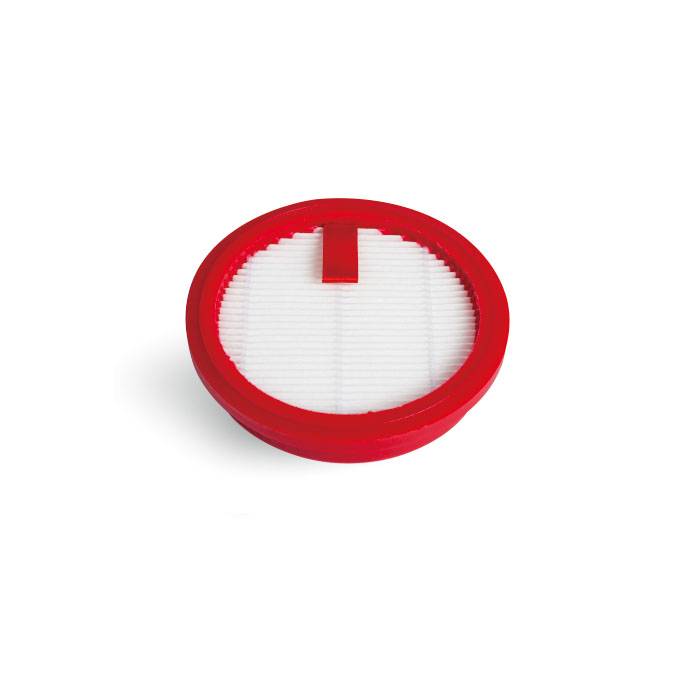
A circular HEPA filter element for handheld vacuums, robot vacuums and mattress cleaners, built by Oltaven around a pleated PTFE membrane or composite PP melt-blown media held in a moulded frame. It captures fine dust, PM2.5, pollen, dust mites and hair from the collected air before it leaves the machine, protecting the motor and the room. It is made for vacuum brands, appliance OEMs and aftermarket suppliers who need a finished filter matched to a specific dust cup and airflow path.
Filter media is the starting point, not the product. A roll of PTFE membrane or PP melt-blown cloth has a certain pore structure and a certain efficiency, but what the user installs is a disc of a particular diameter, thickness and pleat count, seated in a frame and sealed at the edge. Those decisions change how the finished part behaves.
Pleating is the first lever. More pleats place more media inside the same circular footprint, which raises dust-holding capacity and stretches the service interval. Pleats also space the media apart so air can travel between the folds; if the geometry is too tight, the folds close under pressure and resistance climbs. Oltaven treats pleat count and pleat height as a matched pair rather than an open-ended number, because a dense pack that blocks airflow costs suction at the nozzle.
Forming is the second lever. A circular element needs an outer frame that holds its shape under repeated vacuum pressure and a sealing edge that keeps unfiltered air from slipping past the media. The specifications for this product include moulded frames in environmentally acceptable plastic and a rubber sealing ring around the rim to protect airtightness, so dust does not bypass the element and return to the exhaust stream. Framing is also where fit is decided: the outer diameter, thickness and any locating features must follow the dust cup and the housing they slide into, not the other way round.
Sealing, media grade and pleat geometry therefore work as one system. The same membrane can give a low-resistance element or a restrictive one depending on how it is formed. Oltaven sells finished filters because the value for a vacuum programme sits in that combination, not in the raw material alone.
Three outcomes matter to a vacuum designer: efficiency, resistance and capacity. Each is set partly by media and partly by forming.
Efficiency depends on pore size in the PTFE membrane or the fibre structure of the PP melt-blown layer, and on a complete seal at the frame. A high-efficiency medium with a leaky edge lets dust through around the media, so the rubber sealing ring and the frame bond carry real weight. For this circular element Oltaven states filtration efficiency of H11 to H13, with at least 99.95% capture of particles at 0.3 µm for the H13 level. The element is designed to intercept PM2.5, dust mites, pollen and hair, and to stop exhaust air from carrying fine dust back into the room.
Resistance is the pressure the motor must overcome to move air. High-porosity, breathable media and an open pleat pattern keep resistance low, which preserves suction and reduces motor heating. Lower resistance also helps battery runtime in cordless machines, because the motor does less work for the same airflow. A filter that is efficient but too tight will make a handheld vacuum feel weak, which is why media grade and pleat spacing are selected together.
Capacity is how much dust the element holds before resistance rises to the point where the user notices. Deep pleats and high loft media store more dust. Capacity and resistance trade against each other, and the right balance depends on the machine: a robot vacuum running long, low-power cycles needs a different balance from a handheld used in short bursts at high suction.
Oltaven also offers PTFE media that can be washed, so a single element can be rinsed and reused. Customers can choose a washable PTFE version or a standard non-washable version depending on how the end market is positioned, and the instruction wording on packaging follows that choice.
This circular HEPA element is used in handheld cordless vacuums, robot vacuums and mopping vacuums, mattress mite-removal cleaners and compact car vacuums. In each case the filter sits downstream of the dust cup and upstream of the motor and exhaust, so it protects both the machine and the indoor air.
Handheld vacuums benefit from low resistance, because every pascal saved is suction at the tool and runtime from the battery. Robot vacuums run unattended for long periods, so capacity and a stable seal matter more than peak airflow. Mattress cleaners are judged on what leaves the exhaust, which makes fine-particle capture and a tight frame edge the priority. Because Oltaven matches the outer frame to the device airflow path and dust cup, the same construction approach can be adapted across these categories rather than rebuilt for each one.
| Item | Detail |
|---|---|
| Product name | Vacuum cleaner filter element / robot vacuum filter (circular shape) |
| Core filtration media | High-precision PTFE microporous membrane, composite PP melt-blown media, or antibacterial-treated filter paper |
| Core purification function | Captures fine particles (PM2.5), dust mites, pollen and hair from the dust cup, and prevents secondary pollution from exhaust air |
| Physical and airflow characteristics | High-porosity breathable design with low operating resistance and high dust-holding capacity; helps prevent motor overheating and supports battery runtime |
| Main end uses | Handheld cordless vacuums, robot vacuums, mattress mite-removal cleaners, mopping vacuums, compact car vacuums |
| Frame and size customisation | Made to the device airflow path and dust cup dimensions; moulded plastic frame and rubber sealing ring around the rim for airtightness and no dust leakage |
| Filter efficiency | H11 to H13; at least 99.95% capture of particles at 0.3 µm at H13 |
| Company certification system | 50,000 m² production base and a CNAS-accredited testing laboratory; ISO 9001, ISO 14001 and IATF 16949 quality management systems |
Oltaven is a filter developer and manufacturer with more than 20 years of experience, exporting to Europe, the United States, Japan and South Korea for over two decades. OEM/ODM work is central to what we do: we have developed more than 1,000 filtration solutions, with customisation of dimensions, structure, media grade, frame material, logo and packaging. That experience is why we approach a circular vacuum filter as a formed assembly rather than a cut disc.
The production base covers 50,000 m², including six cleanrooms with a combined area of 20,000 m². Our in-house laboratory is CNAS-accredited and issues test reports on filtration efficiency, dust-holding capacity and resistance. We hold ISO 9001, ISO 14001 and ISO 45001 system certification, and in 2024 we obtained IATF 16949 automotive quality management system certification. Products comply with REACH and RoHS environmental requirements, and compliance documents can be supplied. IQC, IPQC and OQC checks run through incoming material, production and outgoing goods. The company is based in Zhongshan, Guangdong, China.
To quote a circular HEPA element accurately, we need the device or vacuum model, the size or a drawing of the existing filter, the airflow or suction target, the operating conditions (dust load, washable or not, indoor environment) and the quantity you expect per order or per year. Send these details through our contact page and our team will come back with a media and forming proposal, sampling plan and pricing for a long-term supply partnership.
Size fixes the footprint, not the airflow path. Resistance depends on media porosity, pleat count and pleat spacing, and on how tightly the frame seals. Two circular elements of the same diameter can differ noticeably if one uses a dense pleat pack and the other an open pattern. Oltaven selects media grade and pleat geometry together so the finished element matches the motor's suction curve.
The element is offered at H11 to H13 efficiency, with at least 99.95% capture of particles at 0.3 µm at the H13 level. It is designed to intercept PM2.5, dust mites, pollen, hair and fine dust from the dust cup. Efficiency also depends on a complete seal, which is why the frame and rubber rim are part of the specification.
Yes. Oltaven makes the circular element to the device airflow path and dust cup dimensions, so outer diameter, thickness, pleat count and frame shape follow your machine. Moulded frames and a rubber sealing ring protect airtightness. Customers can also choose media type, including washable PTFE, and add their logo and packaging.
It starts with the device model, size or drawing, airflow target, operating conditions and quantity. We then propose media and structure and produce samples, typically in 7–15 days. Standard items usually have an MOQ of 3,000 pieces; custom moulded products generally start at 5,000 pieces. Sampling fees for custom work can be credited against the bulk order.
Standard lead time is 25–35 days after order confirmation. Peak season or very large orders should be scheduled in advance. Multiple automated lines and material stock support stable delivery for high-volume programmes, and long-term customers can arrange VMI inventory management.
For normal household use, replacement is generally every 3–6 months depending on use frequency and environment. Oltaven offers a non-washable version with higher efficiency and a washable PTFE version that can be rinsed and reused for 6–12 months. The packaging and instructions are marked according to the version supplied.
The company holds ISO 9001, ISO 14001 and ISO 45001 certification and obtained IATF 16949 in 2024. Materials comply with REACH and RoHS, and compliance documents can be provided. The CNAS-accredited laboratory issues reports on efficiency, dust-holding capacity and resistance to support market entry.
Incoming material, in-process production and outgoing goods are checked under IQC, IPQC and OQC. The CNAS laboratory tests filtration efficiency, dust-holding capacity and resistance, so each batch can be compared against the agreed specification. Production runs in a 50,000 m² plant that includes six cleanrooms totalling 20,000 m². Share your requirements through our contact page to discuss a supply partnership.