
EN
Contact The Oltaven Feeder Desiccant Box is a finished moisture-control filter module for automatic dry-food pet feeders and grain storage bins. It takes in the humid air inside the hopper and…
FILTER MEDIA / ROLLS · SHEETS · DIE-CUT
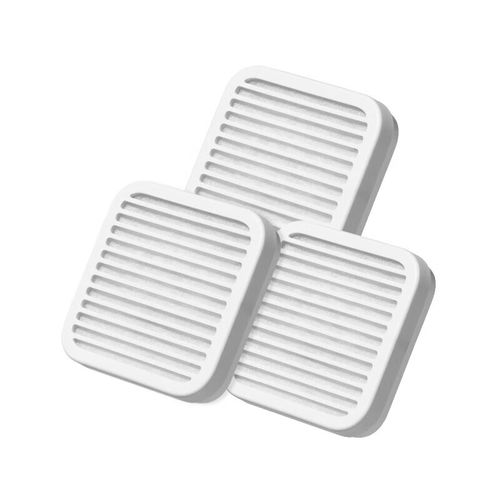
The Oltaven Feeder Desiccant Box is a finished moisture-control filter module for automatic dry-food pet feeders and grain storage bins. It takes in the humid air inside the hopper and holds it in food-contact desiccant media so the kibble stays dry and free-flowing. It is built for pet-appliance brands, feeder manufacturers and private-label sellers who need a drop-in drying component matched to their own housing. Oltaven supplies the finished part, moulded and sealed, not loose desiccant.
A desiccant box looks simple, but its behaviour in a feeder comes from three decisions made before the part is ever shipped: which media goes inside, how the housing is formed, and how the whole module is sealed and mounted. The media sets the ceiling on how much water vapour the box can take up. The forming — the ABS shell, the venting area, the internal non-woven layer — sets how fast that capacity can be reached. The sealing and mounting decide whether the humid air of the hopper actually passes through the media or simply bypasses it.
This is why Oltaven sells the finished filter, not the raw material. Food-grade colour-indicating silica gel or high-efficiency mineral desiccant granules are the starting point, but the same granules placed in an open tray, in a tight capsule or behind a dense vent will behave very differently in service. The module is designed as a system, and the performance figures given to a customer describe that system, not a bag of media.
Four things move the finished result, and each is a design choice rather than a property of the desiccant alone.
Because these factors interact, two boxes of identical outer size can reach different internal humidity and last for different periods. The specification that matters is the humidity level the module holds in a given feeder, not the mass of desiccant printed on the label.
The primary use is dry-food automatic feeders: timed smart feeders, large-capacity hopper feeders and multi-meal dispensers where kibble sits for days or weeks between refills. In these units the box holds the hopper below 60%RH, which slows the moisture uptake, oxidation and mould growth that make dry food clump, lose aroma or turn musty, and reduces the conditions in which insects and eggs can develop.
The same module format suits grain storage bins and sealed treat containers sold alongside feeders, and it can be adapted to other small closed cavities where a consumable drying element is preferred over a powered dehumidifier. Typical buyers are appliance brands adding a serviceable consumable to their feeder platform, OEM feeder makers who want the drying function designed in from the start, and distributors building a replacement-part range. Mounting format, dimensions and media loading are set per device, so the box is matched to the feeder rather than fitted around it.
| Item | Detail |
|---|---|
| Product name | Pet automatic feeder desiccant box / hopper dehumidifying box / anti-mould freshness component |
| Core drying material | Food-grade colour-indicating silica gel / high-efficiency mineral desiccant granules |
| Housing and enclosure | Food-contact ABS plastic shell with an internal high-permeability PET non-woven anti-leak layer |
| Core protective performance | Absorbs free moisture from the air and holds hopper humidity below 60%RH, limiting dampening, oxidative mould and insect development in dry pet food |
| Suggested replacement interval | 30 days per change in normal conditions; 20–25 days in southern China plum-rain season or coastal high-humidity environments (can be paired with a smart-app reminder) |
| Dimensions and mounting customisation | Tooled to the customer's device dimensions; top-cap clip, threaded twist and drawer mounting structures supported for tool-free replacement |
| Quality system | Material safety supported by a national CNAS-accredited testing centre; company certified to ISO 9001, ISO 14001 and IATF 16949 |
Oltaven is an OEM/ODM filter manufacturer, and the desiccant box is one of more than 1,000 filtration solutions developed with customers to date. Production runs in a 50,000 m² plant in Zhongshan, Guangdong, China, which includes six cleanrooms totalling 20,000 m² — the filling and sealing of desiccant modules takes place in these controlled rooms so the media is not exposed to dust or ambient moisture before packing.
Material safety is checked in our own CNAS-accredited laboratory, which issues test reports on filtration efficiency, dust-holding capacity and resistance. The company holds IATF 16949 (obtained in 2024) together with ISO 9001, ISO 14001 and ISO 45001, and products meet REACH and RoHS requirements with compliance documents available on request. Quality control follows IQC, IPQC and OQC stages across multiple automated lines.
To quote a Feeder Desiccant Box, tell us the feeder or device model, the size or a drawing of the cavity, the target humidity and replacement interval, your operating conditions (indoor, coastal, seasonal), and the quantity you expect for the first order and per year. Send these details through our contact page and our team will come back with a proposed configuration and sample plan.
Because the finished result depends on media loading, vent area, the internal non-woven layer, and how well the box seats in the hopper. A box with more open venting reaches working humidity faster, while a tighter housing may hold capacity longer but respond slowly. Oltaven specifies each module against the feeder it is designed for, not by outer size alone.
Food-grade colour-indicating silica gel or mineral desiccant granules take up free moisture from the air inside the hopper. With the correct loading and vent path, the module holds hopper humidity below 60%RH in normal use, which slows dampening, oxidative mould and insect development in dry kibble.
Yes. Dimensions are tooled to your device, and top-cap clip, threaded twist and drawer mounting structures are all supported so owners can change the box without tools. Media type, loading, housing colour, logo, packaging and instruction labels can also be specified under OEM/ODM.
Send the feeder model, cavity size or drawing, target humidity, operating conditions and expected quantity. We propose a media and housing configuration, then supply samples for fit and field testing in your own feeder before tooling and volume release. The quotation follows the confirmed configuration.
MOQ and lead time are set per project, depending on whether the box is a standard format or a new tooling design, and on the media and packaging selected. Share your forecast and launch date and we will confirm both in the quotation.
In normal conditions we suggest a change every 30 days; in southern China plum-rain season or coastal high-humidity environments, every 20–25 days. Colour-indicating silica gel shows when the media is spent, and the interval can be paired with a smart-app reminder on the feeder.
It starts with your feeder model, a size drawing or sample, the humidity target and the expected replacement interval. We then select media and loading, propose the vent and mounting design, and move to samples and tooling once the configuration is agreed.
Products meet REACH and RoHS requirements and compliance documents can be provided. Material safety is supported by our CNAS-accredited laboratory, and the company is certified to ISO 9001, ISO 14001, ISO 45001 and IATF 16949. Tell us your market requirements through the contact page and we will confirm the documents available.