
EN
Contact This is a finished cylindrical HEPA filter with granular activated carbon, made by Oltaven for desktop and bedside air purifiers, car purifiers and small fresh-air modules. It removes fine…
FILTER MEDIA / ROLLS · SHEETS · DIE-CUT
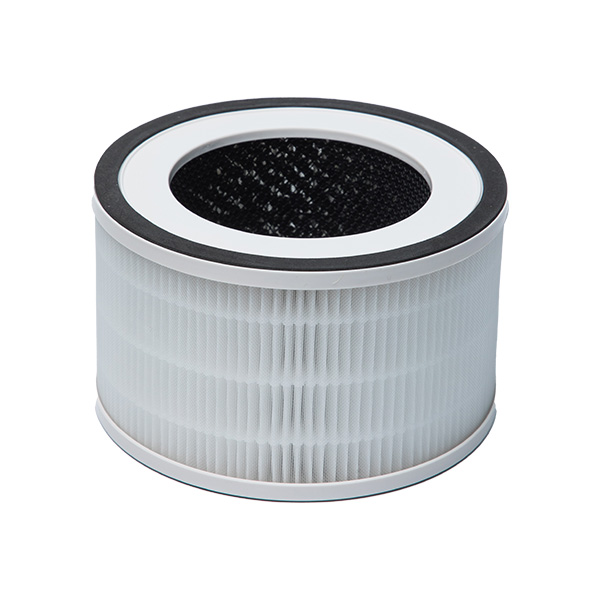
This is a finished cylindrical HEPA filter with granular activated carbon, made by Oltaven for desktop and bedside air purifiers, car purifiers and small fresh-air modules. It removes fine particles such as PM2.5, pollen, dust and bacteria, and the carbon layer also tackles formaldehyde, TVOC and odours. It is built for appliance brands and OEM teams that need a filter shaped to their own air path rather than a catalogue size.
A filter starts as flat media, and the finished part is what the machine actually breathes through. The media sets the upper limit: high-precision PP, moisture-resistant PP+PET composite or PTFE microporous membrane each behave differently. But pleating decides how much of that media sits in the frame, framing holds the pleats at a fixed spacing, and sealing stops air from slipping around the edges. Oltaven sells the finished filter, so these choices are made together and tested together.
Pleating is the first lever. Tighter pleats put more surface area into the same footprint, which normally lowers resistance and raises dust capacity, but past a point the pleats touch and the gain disappears. Framing and sealing then protect that gain: a stable frame keeps pleat spacing even, and a clean seal keeps unfiltered air from bypassing the media. The carbon stage is added in the same build, with high-iodine-value granular coconut-shell carbon or catalyst-modified carbon for formaldehyde, filled in a targeted way so the gas stage does not choke the airflow.
Three outcomes matter to a device maker: efficiency, resistance and capacity. Efficiency is set mainly by media grade, with HEPA classes from F7 to H13 available, chosen against the device airflow and the target cleaning result. Resistance is set by media, pleat density and how evenly the frame holds the pleats; a filter that is too tight for its fan loses airflow and makes more noise. Capacity is set by usable media area and carbon load, and it decides how long the filter lasts before replacement.
The same three outcomes are why two filters of the same outer size can behave differently. One may use a thicker media with fewer pleats, another a thinner media with more pleats; one may seal the ends cleanly, another may leak. Oltaven treats the filter as one system: media choice, pleat forming, frame and seal, then carbon filling, so the finished part matches the device rather than only the drawing.
These filters are used in desktop and bedside micro air purifiers, car air purifiers, fresh-air ventilation modules and humidifying-purifying combos. The common forms are rectangular flat panels, cylinders and custom sector or polygon shapes for small appliances. Because the filter is often hidden inside a compact housing, the shape and seal have to follow the device air path closely; that is why 100% flexible OEM/ODM tooling is offered for length, width, thickness and foam sealing edges, as well as for cylindrical formats.
The two-in-one thin composite structure frees space inside small housings. The granular carbon is filled in a targeted way to lock in formaldehyde, while the HEPA stage handles particles. For appliance brands, the result is a filter that can be sized to the chassis, tuned to the fan and branded for the end user.
| Item | Detail |
|---|---|
| Product name | HEPA & Granular Activated Carbon Filter |
| Particle filtration media | High-precision PP polypropylene / moisture-resistant PP+PET composite / PTFE high-efficiency microporous membrane |
| Gas-phase media | High-iodine-value coconut-shell granular activated carbon / catalyst-modified activated carbon for formaldehyde removal |
| Particle filtration efficiency | HEPA grade selectable from F7 to H13, customised to device airflow and purification target |
| Common forms | Rectangular flat panel, cylindrical, sector and special polygon shapes for small appliances |
| Typical host products | Desktop/bedside micro air purifiers, car air purifiers, fresh-air ventilation modules, humidifying-purifying combos |
| Size customisation | 100% OEM/ODM flexible tooling; any length, width, thickness and foam sealing edge to match the device air path and structure |
| Quality systems | ISO 9001, ISO 14001 and IATF 16949; factory quality controlled by a CNAS-accredited laboratory |
Oltaven supports OEM/ODM work and has developed more than 1,000 filtration solutions. The production base covers 50,000 m², including six cleanrooms totalling 20,000 m². A CNAS-accredited laboratory issues test reports for filtration efficiency, dust capacity and resistance. The plant holds IATF 16949, ISO 9001, ISO 14001 and ISO 45001, and products meet REACH and RoHS requirements with compliance documents available. The company has more than 20 years of filtration R&D and manufacturing experience, exporting to Europe, the US, Japan and Korea for over 20 years, and is located in Zhongshan, Guangdong, China.
To quote accurately, send the device or vehicle model, size or drawing, airflow or water flow, operating conditions and quantity. Oltaven will reply with a proposed filter build and the next steps. Contact Oltaven to start the conversation.
Resistance comes from the media, pleat density and how evenly the frame holds the pleats. A filter with tighter pleats has more media area but can choke if the pleats touch, while a looser pleat pattern keeps airflow easier. Oltaven tunes these variables to the device fan so the finished filter balances efficiency and resistance.
It starts with your device model, cavity size or drawing, target airflow or CADR, and efficiency target. Oltaven then proposes media, pleat, frame, seal and carbon filling, and builds samples for testing. The process moves to approval, pilot run and mass production with IQC, IPQC and OQC checks.
HEPA grades from F7 to H13 are available, with the grade chosen to match device airflow and purification target; higher HEPA classes can reach up to 99.995% for 0.3 μm particles when specified. Typical uses are desktop and bedside air purifiers, car purifiers, fresh-air modules and humidifying-purifying combos. A carbon stage can be added for formaldehyde, TVOC and odours.
Yes. Oltaven offers 100% flexible OEM/ODM tooling for rectangular, cylindrical, sector and special polygon shapes. Length, width, thickness and foam sealing edges are made to the device air path, and media grade, frame material, logo and packaging can also be specified.
For standard models, samples are usually free and the customer covers international express costs; custom samples carry a tooling and material charge that can be credited against mass production. MOQ is typically 1,000–2,000 pieces for standard models, with custom MOQ agreed per project. Quotation follows the device details, airflow and quantity you provide.
Sample lead time is generally 7–15 working days depending on customisation complexity. Mass production lead time is usually 25–35 days. For long-term partners, stocking or VMI arrangements can shorten delivery further.
Under normal use of about 8 hours per day, the HEPA filter typically lasts 6–12 months, depending on air quality, usage frequency and pollutant concentration. Replacement can be judged by an RFID tag or by the host device’s timer or pressure sensor. Customers can also specify a dust-capacity target for Oltaven to design against.
Send your device or vehicle model, size or drawing, airflow or water flow, operating conditions and quantity through the contact page. Oltaven’s team will review the requirements and propose a filter build with test data. <a href="/en/contact">Contact Oltaven</a> to begin.