
EN
Contact Oltaven ozone removal filters are finished catalytic filters built on an aluminum honeycomb carrier coated with a proprietary ozone-decomposing catalyst. They convert ozone in air streams…
FILTER MEDIA / ROLLS · SHEETS · DIE-CUT
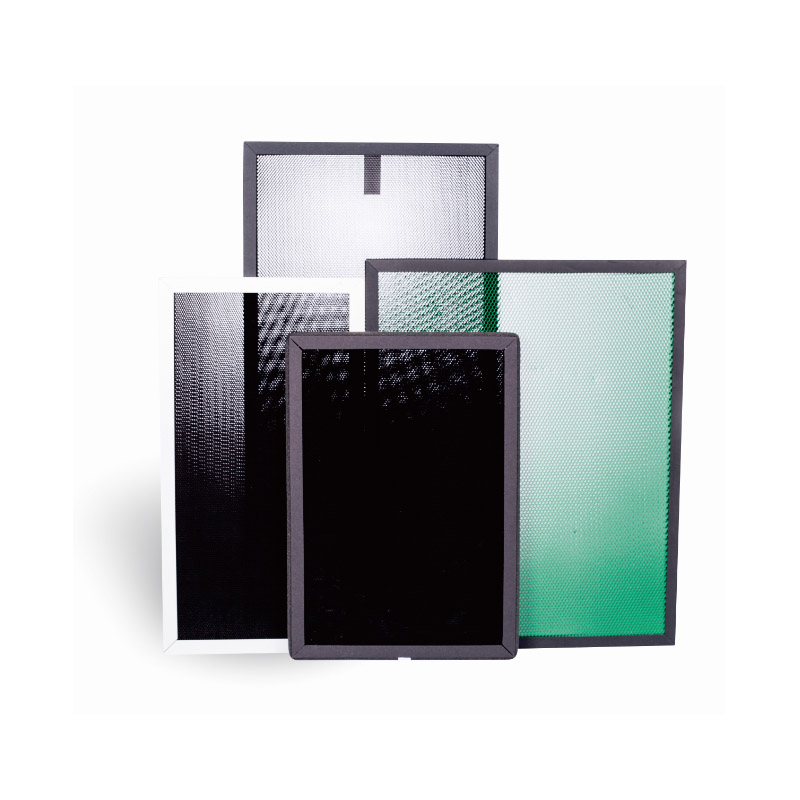
Oltaven ozone removal filters are finished catalytic filters built on an aluminum honeycomb carrier coated with a proprietary ozone-decomposing catalyst. They convert ozone in air streams into oxygen and are used in commercial air purifiers, laser printers, copiers, ozone disinfection equipment and medical exhaust outlets. This page explains how media choice and forming decide efficiency, resistance and capacity, and how Oltaven delivers finished filters – not just media – to OEM and ODM customers.
A finished filter is more than a sheet of catalyst-coated media. The aluminum honeycomb substrate is coated with the catalyst, cut to the required thickness, and then framed or edge-sealed to fit the device. Each step affects how the filter performs in service. The honeycomb structure gives a large catalytic surface in a shallow depth, so ozone contacts the catalyst as air passes through. The catalyst formulation determines how quickly ozone is converted. Cutting and framing determine whether air takes the intended path or bypasses the media. Oltaven supplies the complete finished filter, so the customer receives a part that is ready to install and has been checked for fit and function.
Three factors decide the finished filter’s efficiency, resistance and capacity: the catalyst, the honeycomb geometry and the frame or seal. The catalyst is the active component. Oltaven uses a patented catalyst (patent number ZL200710026260.6) that decomposes ozone on contact. Because the catalyst works at the surface, a uniform coating matters more than a thick coating; excess coating can block airflow without adding useful activity. The honeycomb geometry sets the balance between contact time and pressure drop. Thicker honeycomb gives more contact time but higher resistance; thinner honeycomb reduces resistance but may shorten the effective contact path. Oltaven cuts aluminum honeycomb to various thicknesses so the filter can be matched to the device’s airflow and space. Finally, the frame and edge seal keep air from bypassing the honeycomb. Oltaven offers aluminum alloy frames and sponge or EVA sealing strips to maintain installation airtightness. A filter that fits poorly can show low efficiency even when the catalyst is good, because untreated air escapes around the edges.
These choices also affect capacity and service life. A filter that is correctly matched to the airflow loads the catalyst evenly, while an oversized or undersized filter may load unevenly and lose performance sooner. Oltaven’s approach is to select the catalyst, honeycomb thickness and frame together for each application, then verify the finished part. The result is a filter whose efficiency, resistance and capacity are decided by design rather than by media alone.
Oltaven ozone removal filters are used where ozone is generated as a by-product or as a process gas. Typical installations include high-voltage electrostatic air purifiers, large laser printers, commercial copiers, ozone disinfection equipment (tail-gas treatment) and medical device exhaust outlets. In these devices, the filter is placed in the air path after the ozone source, so that treated air is released to the room or duct. The filter can also be combined with other filter stages in commercial air handling and ventilation systems. Because the finished filter is custom-sized, it can be integrated into new equipment designs or used as a replacement part in existing devices.
| Item | Detail |
|---|---|
| Product name | Ozone Removal Filter / ozone decomposition catalytic filter |
| Core structure and material | Aluminum honeycomb carrier with a proprietary ozone-removal catalyst coating |
| Patent | National invention patent, patent number ZL200710026260.6 |
| Ozone treatment standard | Treated indoor ozone concentration below the national standard of 0.16 mg/m³; meets the UL867 test requirement of ≤0.1 mg/m³ |
| Main end-use applications | High-voltage electrostatic air purifiers, large laser printers, commercial copiers, ozone disinfection equipment tail-gas treatment, medical device exhaust outlets |
| Frame and size customisation | 100% customised to customer equipment dimensions; aluminum honeycomb cut to various thicknesses; optional aluminum alloy frame and sponge/EVA sealing strips for installation airtightness |
| Quality system | Manufactured in a 50,000 m² plant with a CNAS-accredited testing laboratory; ISO 9001, ISO 14001 and IATF 16949 quality management systems |
Oltaven has more than 20 years of experience in filter development and manufacturing, with ongoing exports to Europe, the United States, Japan and South Korea. The company supports OEM/ODM projects and has developed more than 1,000 filter solutions. Production takes place in a 50,000 m² plant that includes six cleanrooms with a combined area of 20,000 m². A CNAS-accredited laboratory can issue test reports for filtration efficiency, dust holding capacity and resistance. Oltaven holds IATF 16949 certification (obtained in 2024) and ISO 9001, ISO 14001 and ISO 45001 system certifications. Products comply with REACH and RoHS environmental regulations, and compliance documents are available.
To receive a quotation, please provide the device or equipment model, the required size or a drawing, the airflow or water flow (if applicable), the operating conditions such as ozone concentration and temperature, and the expected quantity. Oltaven will respond with a proposed specification. Contact us to start your custom filter project.
Resistance depends on the honeycomb thickness, cell density and coating uniformity, not just the outer dimensions. A thicker honeycomb or a heavier catalyst coating can increase resistance, while a thinner or more evenly coated honeycomb can reduce it. Oltaven cuts aluminum honeycomb to various thicknesses and controls the coating so the finished filter matches the device’s airflow.
It starts with your device model, size or drawing, airflow, operating conditions and target quantity. Oltaven reviews the application and proposes a catalyst, honeycomb thickness and frame configuration. A sample is then produced for your evaluation, with sample lead time of about 10–15 days.
Under standard test conditions of 0.1 ppm ozone and 1.0 m/s face velocity, the ozone removal efficiency can reach 95% or higher. Performance data can be supported by test reports from Oltaven’s CNAS-accredited laboratory. Actual efficiency in service depends on ozone concentration, airflow and temperature.
Yes. Oltaven offers 100% customisation to customer equipment dimensions, including aluminum honeycomb cut to various thicknesses and optional aluminum alloy frames or sponge/EVA sealing strips. This helps maintain installation airtightness and fit. Customisation is based on your drawing or size requirements.
Standard specifications typically have an MOQ of 500–1,000 pieces; custom specifications are generally 1,000 pieces or more, depending on size and configuration. Standard products ship in 7–10 days. OEM/ODM samples take about 10–15 days, and batch production usually takes 25–35 days.
In typical commercial air conditioning and ventilation applications, the filter’s service life is usually 12–18 months. Actual life varies with on-site ozone concentration, airflow, temperature and humidity. Oltaven recommends monitoring performance and replacing the filter when efficiency drops below the required level.
Yes. Oltaven welcomes sample requests for performance validation and system fit testing. Standard samples are usually provided free of charge (freight collect); custom samples may incur a development fee that can be credited against a batch order. The CNAS laboratory can also provide test reports to support your evaluation.
Please provide your device model, required size or drawing, airflow, operating conditions and quantity through our contact page. Oltaven will respond with a proposed specification and quotation. Visit <a href="/en/contact">/en/contact</a> to start your inquiry.