
EN
Contact Oltaven's cylindrical humidifier filter is a self-priming evaporative filter made from spunlace non-woven fabric, designed to draw water upward and release it as moisture. It filters…
FILTER MEDIA / ROLLS · SHEETS · DIE-CUT
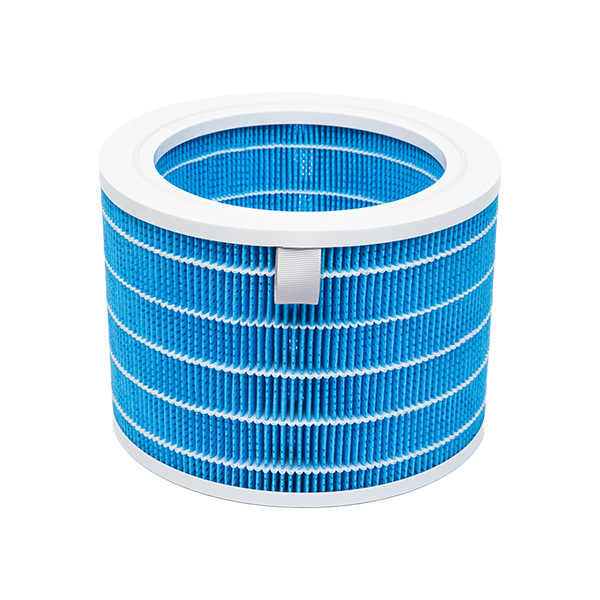
Oltaven's cylindrical humidifier filter is a self-priming evaporative filter made from spunlace non-woven fabric, designed to draw water upward and release it as moisture. It filters airborne dust and intercepts calcium and magnesium ions in the water to help prevent white powder, while its antibacterial and anti-mold treatment resists sour odors. It is intended for humidifiers, air purifiers with humidification, and commercial or industrial humidity-control equipment, and is available as a finished filter with full OEM/ODM customisation.
A humidifier filter's job sounds simple: move water into the air. In practice, the result depends on how the media is chosen and how it is formed into a finished part. At Oltaven, we sell finished filters, not just rolls of fabric. The same spunlace non-woven can behave very differently once it is pleated, shaped into a cylinder, and fitted with end caps. Our role is to match the material and the forming process to the device, the water quality, and the target market.
Spunlace non-woven is made by entangling fibres with high-pressure water jets. This gives a dense, uniform web with strong capillary action, so water climbs quickly and spreads across a large surface. The fabric also keeps its wet strength: it does not soften or collapse after long immersion. Those two properties—capillary rise and wet strength—are the foundation of a self-priming filter. Without them, a filter may hold water but fail to release it efficiently, or it may release water but break down in the tank.
Forming turns that foundation into a working filter. Pleating multiplies the surface area within a compact cylinder, so more water can evaporate at once. The cylindrical shape creates a large contact area with the airflow while keeping the footprint small. End caps and a central core hold the pleats in place and connect the filter to the device. Each of these steps is a chance to improve performance—or to lose it. That is why we treat media selection and forming as one continuous process.
Three outcomes matter most to a humidifier designer: efficiency, resistance, and capacity. Efficiency describes how much moisture the filter can add to the air under given conditions. Resistance is the pressure drop across the filter—higher resistance makes the fan work harder and can increase noise. Capacity is the amount of water the filter can hold and release before it needs attention. Media choice and forming both influence all three.
Media choice sets the baseline. A heavier spunlace fabric (higher grams per square metre) generally holds more water and can last longer, while a lighter fabric may offer lower resistance and faster wet-out. Fibre fineness and web uniformity affect capillary action: a uniform web wicks evenly, avoiding dry patches that reduce efficiency. Our standard spunlace non-woven is available in a range of weights, and we can add antibacterial or anti-scale treatments when the application calls for them.
Pleating and cylinder geometry then fine-tune the balance. More pleats or a larger cylinder height increase surface area and evaporation capacity, but they can also raise resistance if the airflow path becomes too tight. The outer diameter, inner diameter, height, and pleat count therefore need to be matched to the device's fan curve and tank size. Wet strength is another forming consideration: the pleats must stay open and the cylinder must stay rigid after weeks in water. Our filters are built to resist collapse and delamination in long-term immersion.
Sealing and end-cap construction complete the part. A secure bond between media and end caps prevents bypass, where air or water escapes without passing through the filter. It also keeps the cylinder from unwinding. We select end-cap materials and bonding methods to suit the customer's housing and assembly process, so the finished filter arrives ready to install and performs as specified.
These filters are used in household cold-evaporation humidifiers, where they draw water from the tank and release it without a mist. They also fit high-end air purifiers that include a humidification function, combining particle filtration with moisture control. In commercial and industrial humidity-control equipment, the same cylindrical format supports larger air volumes and longer service intervals.
Because every device has its own dimensions and airflow pattern, we customise the filter to the application. For humidifiers with hard water, an anti-scale treatment can help reduce white dust. For devices that sit idle for long periods, enhanced antibacterial protection helps prevent odors. The finished filter is designed around the device, not adapted from a catalogue item.
| Item | Detail |
|---|---|
| Product name | Cylindrical Humidifier Filter / Air Purifier Humidification Core |
| Core filter material | High-absorbency humidification paper / humidification polymer fibre / spunlace non-woven fabric |
| Core performance | Strong water absorption and rapid evaporation; intercepts calcium and magnesium ions in water (helps prevent white powder); long-lasting antibacterial and anti-mold protection; removes tank odors |
| Physical structure advantages | Dense pleating creates a large evaporation area; very high wet strength; does not collapse or come apart during long-term immersion in the water tank |
| Main end applications | Household cold-evaporation mist-free humidifiers, high-end air purifiers with humidification, commercial and industrial humidity-control equipment |
| Specification and size customisation | 100% OEM flexible customisation supported. Outer diameter, inner diameter, height, pleat count of the cylinder, and whether an antibacterial coating is needed can all be manufactured precisely to your device drawings. |
| Quality certification system | Production relies on the company's 50,000 m² clean workshop; the company has passed ISO 9001, ISO 14001 and IATF 16949 international quality management system certifications and has a national-level CNAS testing laboratory for strict quality control. |
Oltaven is built around OEM/ODM capability. We have developed more than 1,000 filtration solutions, and we apply that experience to every custom humidifier filter, from the first drawing to mass production. Our plant covers 50,000 m², including six cleanrooms totalling 20,000 m², so filters are made in a low-dust environment. A CNAS-accredited laboratory supports testing and verification, and we hold IATF 16949 (achieved in 2024) together with ISO 9001, ISO 14001, and ISO 45001. Our products meet REACH and RoHS requirements, and we can provide compliance documents for your market. With more than 20 years of filtration manufacturing and continuous export to Europe, the United States, Japan, and Korea, we understand the standards our customers need to meet.
To move quickly, please tell us the device or vehicle model, the size or drawing, the airflow or water flow involved, the operating conditions (water hardness, temperature, duty cycle), and your required quantity. With those details, we can recommend a filter construction and prepare a quotation. We invite you to contact our team to begin.
Resistance depends on how the media and pleats interact with airflow. A denser fabric or a higher pleat count can increase surface area but may also tighten the air path. End-cap design and bonding also affect bypass and turbulence. Oltaven balances these factors during sampling so the finished filter matches your device's fan curve.
It starts with your device model, target dimensions, water quality, and volume. We then propose a construction, produce samples in 7–10 working days after confirmation, and validate them with you. Once approved, mass production follows our IQC, IPQC, and OQC process.
Yes. We customise outer diameter, inner diameter, height, pleat count, and whether an antibacterial coating is added. We can also adjust the spunlace fabric weight to suit your target market and device. Simply provide a drawing or sample.
The MOQ for standard cylindrical humidifier filters is typically 1,000 pieces; custom models are quoted based on tooling and material. Standard lead time is 25–35 days after deposit. Large or seasonal orders can be scheduled in advance.
Under normal household use (8 hours per day), we recommend replacement every 3–6 months, depending on water hardness and usage. The filter can be rinsed with clean water to remove mineral deposits, but chemical cleaners are not advised. Upgraded versions with anti-scale treatment may extend service life.
Yes. We offer free standard samples (freight collect) for B2B customers. Custom samples are typically ready in 7–10 working days after specifications are confirmed. Quotations are prepared based on your drawing, material choices, and quantity.
Our production is supported by ISO 9001, ISO 14001, ISO 45001, and IATF 16949 (2024) systems, and we test in a CNAS-accredited laboratory. Products meet REACH and RoHS requirements, and compliance documents can be provided. These systems help ensure batch-to-batch consistency.
We select spunlace non-woven with high wet strength and form the pleats and end caps to hold their shape during long immersion. Our laboratory checks wet strength and dimensional stability as part of routine quality control. This helps the filter stay rigid and effective throughout its service life.