
EN
Contact A cylindrical HEPA filter for car air purifiers is a finished, 360° radial-flow filter element that removes fine particulate matter from cabin air inside a vehicle. It is built from pleated…
FILTER MEDIA / ROLLS · SHEETS · DIE-CUT
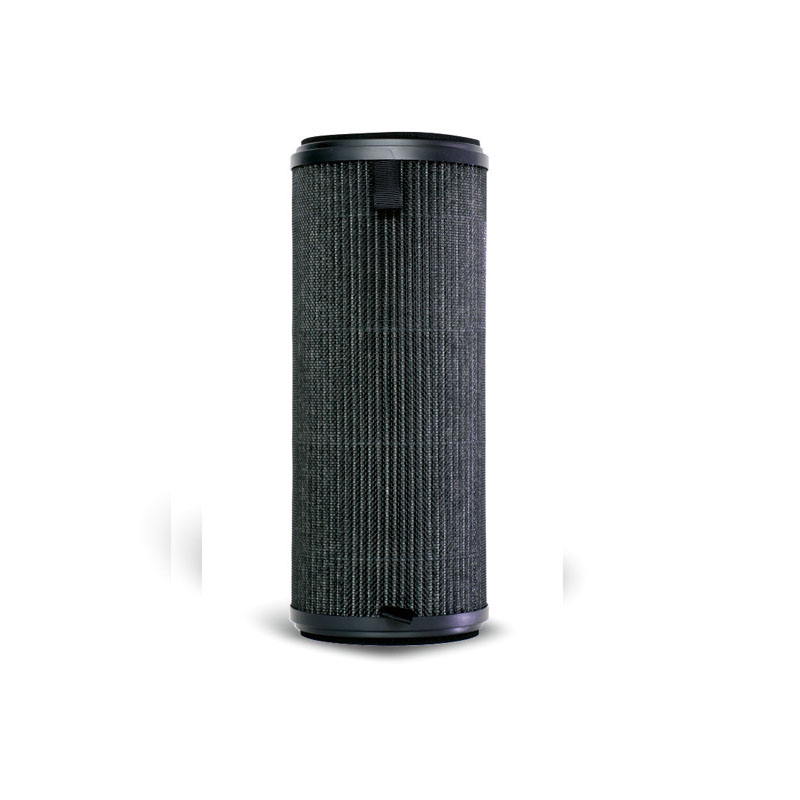
A cylindrical HEPA filter for car air purifiers is a finished, 360° radial-flow filter element that removes fine particulate matter from cabin air inside a vehicle. It is built from pleated PP, PP+PET or PTFE media and is available in H11 to H13 HEPA grades, with optional pre-filters or activated carbon layers. Oltaven manufactures the complete element — media, pleating, forming and sealing — for car air purifier brands, distributors and OEM/ODM buyers.
Buyers often compare filter media as if the paper alone decided performance. In a finished cylinder, it does not. The same roll of HEPA media can become a low-resistance long-life element or a high-resistance short-life one, depending on how it is pleated, formed and sealed.
Pleating sets the effective surface area. Tight, high-density pleats pack more media into a small cylinder, increasing dust-holding capacity and lowering face velocity at a given airflow. Forming then turns the pleat pack into a 360° ring, so air enters evenly around the circumference instead of through one flat face. Even airflow distribution keeps pressure drop predictable and lets the whole media area share the dust load. Sealing closes the ends and the base flange, so unfiltered air cannot bypass the media — the step that decides whether the rated efficiency is actually delivered.
At Oltaven we sell finished filters, not media by the roll. Each cylindrical element is a complete assembly: pleated media, formed ring, end caps and base sealing flange, optionally combined with an inner or outer pre-filter or a column of activated carbon. The customer receives a part that can go straight into an air purifier on an assembly line.
Three media families are available. PP meltblown is the economical choice for H11–H13 particulate filtration. PP+PET composite media balances mechanical strength and pleat stability, which matters in vibrating vehicle environments. PTFE media suits high-efficiency grades where low resistance and consistent efficiency are priorities. The selected grade sets the baseline particle removal level; the forming and sealing determine how much of that baseline survives in the finished part.
High-density pleating raises the effective media area inside a fixed cylinder envelope. More area means lower air velocity through the media, which usually means lower resistance and higher dust capacity for the same filtration grade — the mechanism behind the CADR gains a 360° intake design can bring to an air purifier. It also means the filter lasts longer before resistance rises to the point where airflow drops.
The base sealing flange and end caps define the air path. A well-formed seal forces all intake air through the media; a poor one allows bypass, which shows up as reduced efficiency even when the media itself tests well. Oltaven moulds and forms these parts to the customer's drawing, so outer diameter, inner diameter, height and base flange geometry are matched to the purifier housing.
Where the application needs more than particles, an inner or outer preliminary dust screen can be added, or a built-in column or modified activated carbon layer for formaldehyde and odour removal. These layers change resistance and service life, so they are specified together with the HEPA grade rather than added afterwards.
The cylindrical format suits air paths that draw air from all sides. Typical uses include factory-fitted and aftermarket car air purifiers, cup-shaped purifiers that sit in a cup holder, centre-console purifiers, desktop compact purifiers, and combined humidifier-purifier units. The 360° intake design is useful where the housing is narrow and a flat panel filter would create a high-velocity hot spot. Because each element is made to the customer's dimensions, the same construction approach can serve a range of purifier sizes.
| Item | Detail |
|---|---|
| Product name | Cylindrical HEPA Filter for Car Air Purifier |
| Structure | 360° annular air intake, high-density pleating, maximised effective area |
| Core media options | PP meltblown, PP+PET composite, PTFE high-efficiency media |
| Filtration efficiency | H11 to H13 HEPA grades available, selected to the end purifier's requirements |
| Composite upgrades | Optional inner or outer preliminary dust screen; optional built-in column or modified activated carbon layer for formaldehyde and odour removal |
| Core applications | Factory-fitted and aftermarket car air purifiers, desktop compact purifiers, humidifier-purifier combinations |
| Dimensions | Tooled to customer requirements: outer diameter, inner diameter, height and base sealing flange design |
| Quality system | Produced with 20,000 m² of cleanroom space; IATF 16949 automotive quality management system and ISO 9001/14001 certified |
Oltaven works as an OEM/ODM partner and has developed more than 1,000 filtration solutions over 20 years of research and manufacturing experience. That project history is the practical base for custom cylindrical elements: dimensions, media grade, framing and packaging are all built around a customer's purifier rather than a catalogue list.
The production base covers 50,000 m², including six cleanrooms with a combined area of 20,000 m². Filter elements are produced, assembled and packed in these controlled rooms to limit secondary contamination. Our in-house laboratory holds CNAS accreditation and can issue test reports covering filtration efficiency, dust-holding capacity and resistance, which buyers can use when validating a specification. The plant holds IATF 16949 automotive quality management certification, obtained in 2024, alongside ISO 9001, ISO 14001 and ISO 45001 system certification. Products meet REACH and RoHS requirements, and compliance documents can be supplied. IQC, IPQC and OQC checks cover the process from incoming material to outgoing goods, and automated production lines support monthly output in the millions of pieces. The company is located in Zhongshan, Guangdong, China, and has exported to Europe, the United States, Japan and Korea for more than 20 years.
To move a cylindrical HEPA project forward, send us the device model, size or drawing, required airflow, operating conditions and estimated quantity. Our team will respond with a media and forming proposal and a quotation. Contact Oltaven to discuss your requirements.
Pleat density and effective media area are the main reasons. A cylinder with more, tighter pleats packs more media into the same envelope, lowering air velocity through the medium and reducing resistance. Media type also matters: PTFE and PP+PET behave differently from plain PP meltblown at the same grade.
It starts with your purifier model, a size or drawing, the required airflow and the target HEPA grade. Oltaven then proposes media, pleating and forming, and quotes tooling and unit price. A sample is made for fit and performance checks before volume production.
The cylindrical HEPA filter is available in H11 to H13 grades, selected according to the end purifier's requirements. Efficiency is specified together with media type and composite options, because an added carbon layer or pre-filter changes resistance and service life.
Yes. Outer diameter, inner diameter, height and base sealing flange design are tooled to customer requirements. The 360° annular intake and high-density pleating are then formed around those dimensions so the element fits the purifier housing.
Yes. Share the drawing or dimensions and target specification, and Oltaven will arrange a sample for fit and performance evaluation. Sampling and quotation are handled together so the approved sample matches the quoted production part.
MOQ and lead time depend on the tooling and media combination, so they are confirmed in the quotation for each project. Once the specification is fixed, Oltaven schedules production on its automated lines and confirms delivery dates with the order.
Replacement depends on vehicle environment, pollution level and daily running hours, so it should be set from the purifier's duty cycle. The CNAS laboratory can test efficiency, dust-holding capacity and resistance to support a replacement recommendation.
Send the device model, size or drawing, airflow, operating conditions and estimated quantity through our contact page. The team will reply with a media and forming proposal and pricing. <a href="/en/contact">Contact Oltaven</a> to begin.