
DE-DE
Kontakt A dust bag with an interchangeable cover is a finished filter component for robot vacuum auto-empty bases, handheld cordless vacuums and commercial vacuum bins. It captures fine dust…
FILTER MEDIA / ROLLS · SHEETS · DIE-CUT
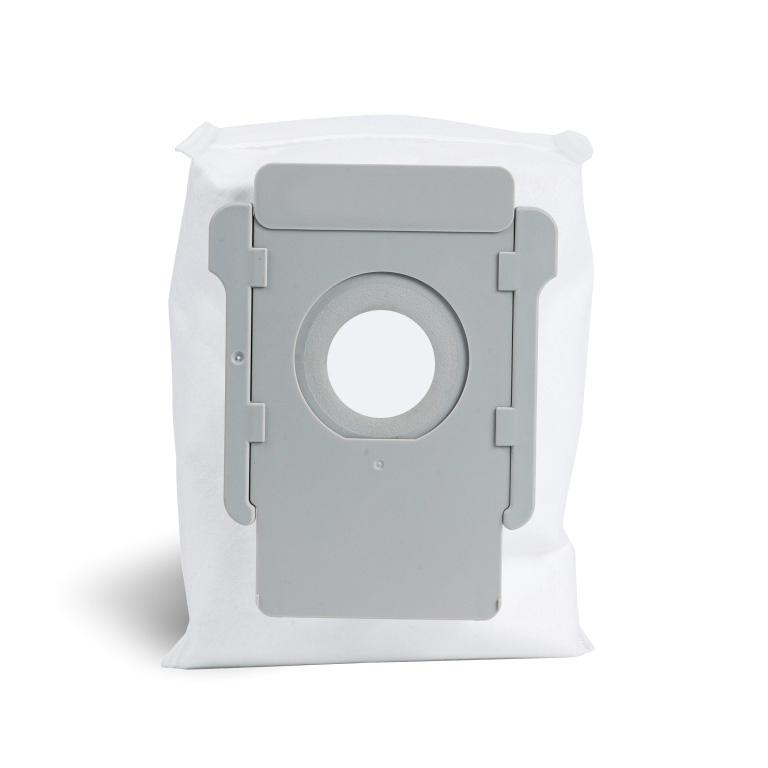
A dust bag with an interchangeable cover is a finished filter component for robot vacuum auto-empty bases, handheld cordless vacuums and commercial vacuum bins. It captures fine dust (PM2.5), dust mites, pollen, hair and other household allergens using a multilayer composite PP (polypropylene nonwoven plus meltblown) construction, so exhaust air does not reintroduce collected dust into the room. It is made by Oltaven for appliance brands, distributors and OEM/ODM buyers who need the bag, the cover interface and the sealing action to work together as one part.
Many buyers compare dust bags by the roll of media inside them. In practice, the media is only one input. A finished bag is the result of several operations: the PP nonwoven and meltblown layers are combined, the bag body is formed and closed, the cover or card interface is attached so it fits the dock, and the sliding sealing feature is built in so the bag closes when it is removed.
Each step changes what the finished part can do. Combining layers sets the starting filtration level. Forming and closing determine whether air can bypass the media. The cover interface determines fit and seal at the docking port. The sliding seal determines whether dust stays inside during removal. Oltaven sells finished filters, not just media, so all of these decisions are made together against the customer's device.
Three outcomes matter most to a device brand: efficiency, resistance and dust capacity. Media choice sets the ceiling for each, and forming and sealing decide how much of that ceiling the finished bag actually reaches.
Efficiency depends on the meltblown layer in the multilayer composite. The meltblown web carries the fine-fibre structure that intercepts small particles, while the PP nonwoven layers support it and protect it from abrasion. If the layers are combined poorly, or if the bag body is not closed correctly, air finds paths around the media and efficiency drops even when the media itself is capable.
Resistance is decided by media permeability and by how much of the bag surface is actually open to flow. A high-porosity breathable design keeps resistance low, which matters because a robot dock or handheld vacuum has a limited pressure budget. Restricted airflow raises resistance and reduces suction at the cleaning head, so the bag shape and the way it sits in the dock are as important as the media grade.
Capacity comes from the bag volume and from how the media behaves as it loads. A bag with high dust holding capacity fills progressively without its resistance rising sharply, so suction stays strong between changes. The cover interface is part of this picture: a stable connection at the dock keeps the airflow path predictable for the whole service interval.
The sealing action completes the design. The sliding handle closes the bag as it is withdrawn, so the user does not handle the collected dust. This is a forming and assembly feature, not a media feature, and it is one reason a finished bag differs from cut media.
Because the part is a system component, the right starting point for a project is the device itself: the dock geometry, the interface type and the airflow the appliance can deliver.
| Item | Detail |
|---|---|
| Product name | Dust bag for handheld vacuums and auto-empty dust bags for robot vacuums |
| Core media construction | Multilayer high-precision composite PP (polypropylene nonwoven plus meltblown) / antibacterial filter cotton material |
| Filtration function | High-precision interception of fine dust (PM2.5), dust mites, pollen, hair and other household allergens; prevents secondary exhaust contamination |
| Airflow characteristics | High-porosity breathable design, very low operating resistance, high dust holding capacity; does not sap the motor's suction |
| Main end uses | Robot vacuum auto-empty bases, handheld cordless vacuums, commercial vacuum bins |
| Size and cover customisation | 100% flexible customisation to device dimensions. Cardboard interfaces and eco-friendly injection-moulded plastic interfaces; sliding auto-seal and activated-carbon odour-control versions available |
| Company systems | 50,000 m² modern clean production plant and a CNAS-recognised testing centre; ISO 9001, ISO 14001 and IATF 16949 quality management systems |
Efficiency figures, dust capacity and service life are confirmed against the agreed specification for each project rather than assumed from the media alone.
Oltaven supports OEM/ODM programmes and has developed more than 1,000 filtration solutions. That experience is useful at the point where a standard bag almost fits a dock but not quite: the cover interface, bag dimensions and sealing action can be reworked as one design.
Production runs in a 50,000 m² plant in Zhongshan, Guangdong, China, which includes six cleanrooms totalling 20,000 m². Cleanroom assembly suits dust bags because it limits contamination before the bag is packed. The in-house laboratory holds CNAS (China National Accreditation Service for Conformity Assessment) recognition and can issue test reports on filtration efficiency, dust holding capacity and resistance.
The company holds IATF 16949, awarded in 2024, together with ISO 9001, ISO 14001 and ISO 45001 system certification. Products meet REACH and RoHS requirements, and compliance documents can be supplied. Quality control covers IQC, IPQC and OQC through the production flow, and multiple automated lines support output of up to several million pieces per month. Oltaven has more than 20 years of filtration product development and manufacturing experience and has exported to Europe, the United States, Japan and Korea for over 20 years.
To quote accurately, Oltaven needs the device or vehicle model, the bag size or a drawing, the airflow available at the dock, the operating conditions, and the quantity you plan to order. If the interface is proprietary, send a sample or 3D model so the cover can be matched. Contact the Oltaven team with these details and we will respond with a proposal for the finished bag.
Resistance depends on media permeability and on how much of the bag surface is open to airflow, not on outer dimensions alone. Two bags can share the same footprint while using different composite PP builds, pleat or bag forming, and interface designs. The finished part, not just the media, sets the resistance the appliance actually sees.
It starts with the device: the dock or vacuum model, a sample, drawing or 3D model, and the interface type. From there Oltaven agrees the filtration level, airflow budget and expected service interval, selects media and construction, and builds samples for fit and seal approval before volume production.
The multilayer composite PP construction is designed to intercept fine dust (PM2.5), dust mites, pollen and hair, and to prevent secondary exhaust contamination. Because efficiency is set by media choice plus forming and sealing, the exact figure is confirmed against the agreed specification, with reports available from the CNAS-recognised laboratory.
Yes. Sizes are customised 100% to device dimensions, with cardboard interfaces or eco-friendly injection-moulded plastic interfaces, plus sliding auto-seal and activated-carbon odour-control options. Send a sample, drawing or 3D model so the cover interface and bag can be matched to the dock.
Yes. Share the device model, bag size or drawing, airflow at the dock, operating conditions and planned quantity, and Oltaven will prepare a quotation. Samples are built so fit, seal and airflow can be checked on the actual appliance before tooling or volume production.
MOQ and lead time are set per project according to bag specification, interface type and order volume. Multiple automated lines support output of up to several million pieces per month, which suits both initial orders and repeat supply. Confirm the figures with the team when the specification is agreed.
Replacement depends on the appliance, the dust load in the home and the bag's dust holding capacity. The high-porosity design keeps resistance low as the bag fills, so suction holds up between changes. Agree the expected service interval during the project so packaging and instructions match it.
Oltaven holds ISO 9001, ISO 14001, ISO 45001 and IATF 16949 (awarded 2024) system certification, and products meet REACH and RoHS requirements with compliance documents available. The in-house laboratory holds CNAS recognition and can issue reports on filtration efficiency, dust holding capacity and resistance. Contact us with your device details to start.