
DE-DE
Kontakt Oltaven's water purifier sintered activated carbon rod Ф60×240 is a solid carbon block filter element made from high-iodine coconut shell activated carbon and food-grade ion exchange resin.…
FILTER MEDIA / ROLLS · SHEETS · DIE-CUT
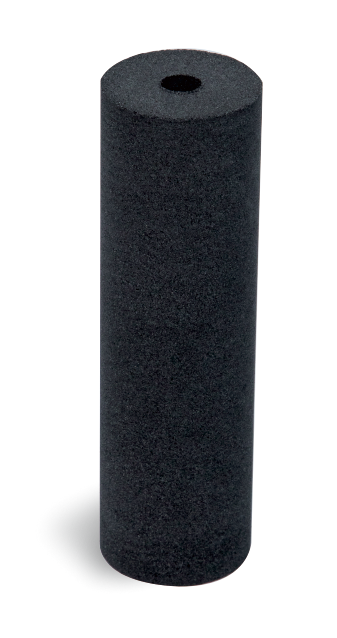
Oltaven's water purifier sintered activated carbon rod Ф60×240 is a solid carbon block filter element made from high-iodine coconut shell activated carbon and food-grade ion exchange resin. It is designed to reduce chlorine, odours, colour, and heavy metals such as lead and mercury, while softening water by inhibiting scale formation. This filter is intended for household reverse osmosis systems, direct drinking water dispensers, refrigerator water filters, and commercial coffee machines. Oltaven is a manufacturer based in Zhongshan, Guangdong, China, specializing in filtration solutions.
The performance of a carbon block filter is not determined by the carbon media alone. It is the result of how the media is selected, blended, formed, and sealed into a finished cartridge. Oltaven sells finished filters, not just media, because the forming process—pleating, framing, and sealing—ultimately decides the final efficiency, resistance, and capacity of the product.
The media choice sets the potential: coconut shell carbon with a high iodine number provides a large surface area for adsorbing chlorine, volatile organic compounds (VOCs), and taste and odour compounds. The addition of food-grade ion exchange resin introduces softening capability and helps reduce certain heavy metals. However, the way these materials are combined and sintered into a block determines how much of that potential is realized in the finished filter.
Forming transforms loose media into a rigid, porous structure. The sintering process binds the carbon particles and resin together without adding binders that could leach or reduce adsorption capacity. The result is a block with a controlled pore structure that allows water to flow through while capturing particles and adsorbing contaminants. The outer dimensions, inner bore, and end-cap design are all part of the forming step, and they must match the housing or system where the filter will be installed.
Sealing and framing ensure that water passes through the filter media rather than bypassing it. End caps, gaskets, and bonding methods are selected to create a leak-free seal that withstands operating pressure and temperature. The choice of materials and the precision of assembly affect the filter's integrity and its ability to deliver consistent performance over its service life.
In short, a finished filter is an engineered system. The media provides the adsorption and ion exchange functions, while the forming and sealing steps determine the flow characteristics, mechanical strength, and reliability of the final product. Oltaven controls these steps to deliver filters that meet the specified performance criteria.
Several factors interact to determine the efficiency, resistance, and capacity of a sintered activated carbon rod. Understanding these factors helps in selecting the right filter for a given application and in predicting how it will perform in service.
Media selection and blending: The type of activated carbon, its iodine number, and particle size distribution influence adsorption capacity and kinetics. High-iodine coconut shell carbon is chosen for its high surface area and microporosity, which are effective for chlorine and VOC removal. The amount and type of ion exchange resin affect softening performance and heavy metal reduction. The ratio of carbon to resin is balanced to achieve the desired combination of adsorption and ion exchange without compromising flow.
Pore structure and density: The sintering process creates a network of pores within the carbon block. The size and distribution of these pores affect both filtration efficiency and flow resistance. A finer pore structure captures smaller particles and improves mechanical filtration, but it also increases pressure drop. Conversely, a more open structure allows higher flow but may reduce particle capture efficiency. Oltaven optimizes the pore structure to achieve a balance between efficiency and resistance for the intended application.
Dimensions and geometry: The outer diameter, length, and inner bore determine the surface area available for filtration and the path length through the filter. A larger diameter or longer length provides more media volume and thus higher capacity, but it also increases the space required and may affect flow dynamics. The Ф60×240 size is a common format that fits many standard housings. Custom sizes can be developed to match specific system requirements.
End caps and sealing: The end caps direct water flow through the filter media and prevent bypass. The sealing method—whether by gasket, O-ring, or bonding—must be compatible with the housing and operating conditions. A proper seal ensures that all water passes through the filter, maintaining efficiency and preventing contamination. The design of the end caps also affects the pressure drop and the ease of installation.
Manufacturing consistency: Variations in media mixing, sintering temperature, and assembly can lead to differences in performance between production batches. Oltaven's quality control measures, including in-house testing at its CNAS-accredited laboratory, help ensure that each filter meets the specified performance criteria.
By controlling these factors, Oltaven produces finished filters with consistent efficiency, resistance, and capacity. The Ф60×240 sintered activated carbon rod is engineered to deliver reliable performance in water purification applications.
The Ф60×240 sintered activated carbon rod is suitable for a range of water treatment applications where chlorine, odour, colour, and heavy metal reduction are required. Its solid block construction and food-grade materials make it appropriate for potable water systems.
Household reverse osmosis (RO) systems: The filter is commonly used as a pre-filter (CTO) or post-filter (T33) in under-sink RO systems. As a pre-filter, it protects the RO membrane from chlorine and particulate damage; as a post-filter, it polishes the permeate water for taste and odour.
Direct drinking water dispensers: Point-of-use water dispensers, including countertop and stand-alone units, benefit from the filter's ability to reduce chlorine and improve taste. The Ф60×240 size is compatible with many dispenser designs.
Refrigerator water filters: Side-by-side and French-door refrigerators with built-in water filtration often use carbon block filters of similar dimensions. The filter reduces chlorine and odours, improving the taste of drinking water and ice.
Commercial coffee machines: In coffee and espresso machines, water quality affects taste and equipment longevity. The filter reduces chlorine, scale-forming minerals, and odours, helping to maintain consistent beverage quality and protect machine components.
These applications share a common need for reliable reduction of chlorine, taste, and odour, as well as softening and heavy metal reduction. The Ф60×240 sintered activated carbon rod is designed to meet these needs in a compact, standardized format. Custom sizes and configurations are available for OEM/ODM projects to fit specific devices.
| Item | Detail |
|---|---|
| Product name | Water purifier / refrigerator carbon block filter (Carbon Block Water Filter / CTO Filter) |
| Core filtration materials | High-iodine coconut shell activated carbon and food-grade ion exchange resin |
| Core performance | Softens water and inhibits scaling; effectively adsorbs residual chlorine (bleaching powder); removes off-colours and odours; intercepts harmful heavy metals such as lead and mercury |
| Precision and service life | Uniform microporous structure, high initial flow, high filtration precision with no black powder release; large saturated adsorption capacity and long service life |
| Standard size references (outer diameter × length, mm) | Ф60×130 / Ф62×240 / Ф37.5×75 / Ф38×57 / Ф40×195 / Ф51×127 / Ф32×126 / Ф32×106 |
| Main end applications | Household reverse osmosis systems (pre-filter CTO / post-filter T33), direct drinking water dispensers, side-by-side refrigerator water filters, commercial coffee machines |
| Customisation service | Full OEM/ODM support. Regardless of length, diameter, or inner/outer diameter ratio, tooling can be made according to equipment needs; end-cap welding customisation is supported. |
| Quality certification | The company's 50,000 m² production base is certified to ISO 9001 and IATF 16949. Filter materials meet strict potable water safety and hygiene standards, with quality control guaranteed by a national CNAS testing centre. |
Oltaven is a filtration solution provider with over 20 years of experience in R&D and manufacturing, exporting to Europe, the United States, Japan, and South Korea for more than two decades. The company has developed more than 1,000 filtration solutions and offers comprehensive OEM/ODM services, customising dimensions, structures, filter media grades, frame materials, logos, and packaging.
The production base in Zhongshan, Guangdong, China, covers 50,000 m², including six cleanrooms totalling 20,000 m². Multiple automated production lines enable a monthly capacity of millions of filter pieces. Quality management follows IQC, IPQC, and OQC processes. The in-house laboratory is CNAS-accredited and can issue test reports for filtration efficiency, dust holding capacity, and resistance.
Oltaven holds ISO 9001, ISO 14001, and ISO 45001 certifications, and was awarded IATF 16949 in 2024. Products comply with REACH and RoHS environmental regulations, and compliance documents are available upon request.
Oltaven supports customers from initial concept through to mass production. The typical workflow for a custom project is as follows:
This structured approach ensures that custom filters meet the specific needs of each application and are manufactured consistently.
To begin a custom project or to request a quote for the Ф60×240 sintered activated carbon rod, please contact Oltaven with the following information: your device or vehicle model (if applicable), required dimensions or a drawing, airflow or water flow rate, operating conditions (such as pressure and temperature), and estimated quantity. This information will help us provide an accurate proposal and samples for evaluation.
Please contact us to discuss your requirements. Oltaven welcomes partnership inquiries and is ready to support your filtration needs.
Filters of the same size can differ in resistance because of differences in media selection, pore structure, and density. A finer pore structure or higher density increases resistance, while a more open structure reduces it. Oltaven optimizes the balance between efficiency and resistance for each application.
An OEM project starts with a discussion of your requirements, including dimensions, flow rate, operating conditions, and performance targets. Oltaven's engineering team then proposes a design, produces samples for testing, and upon approval proceeds to tooling and mass production. The process is collaborative and includes validation at each stage.
The filter is designed to effectively adsorb residual chlorine and remove off-colours and odours. It also reduces heavy metals such as lead and mercury and helps soften water by inhibiting scale. Efficiency depends on water quality and operating conditions; test reports from the CNAS laboratory can be provided for specific parameters.
Yes, Oltaven supports full OEM/ODM customisation. Regardless of length, diameter, or inner/outer diameter ratio, tooling can be made according to your equipment needs. End-cap welding customisation is also supported to ensure a proper fit and seal.
The MOQ for standard sizes is typically 1,000 to 2,000 pieces, while custom products depend on complexity. Standard stock items ship within 7 to 15 days; OEM orders generally take 25 to 35 days, including tooling confirmation and sampling.
Yes, samples are available for testing. Standard size samples are typically shipped within 3 to 5 working days, while custom samples take 7 to 15 days to develop. Samples include test reports from the CNAS laboratory covering filtration efficiency, chlorine removal rate, and flow-pressure drop data.
The replacement interval depends on water quality and usage. Under normal conditions, the filter can last 6 to 12 months. Monitoring flow rate and taste can help determine when replacement is needed. Oltaven recommends following the device manufacturer's guidelines.
The production base is certified to ISO 9001 and IATF 16949, and the company holds ISO 14001 and ISO 45001 certifications. Products comply with REACH and RoHS regulations, and compliance documents are available. The CNAS-accredited laboratory provides testing for quality control.