
AR
اتصل بنا The Oltaven sintered activated carbon stick filter Ф37.5×75 is a finished carbon block cartridge made from high-iodine-value coconut shell activated carbon, sintered together with…
FILTER MEDIA / ROLLS · SHEETS · DIE-CUT
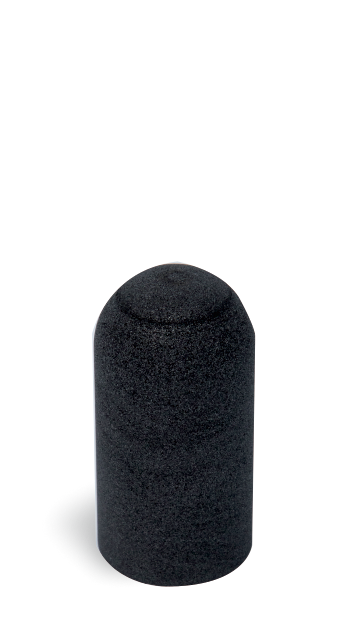
The Oltaven sintered activated carbon stick filter Ф37.5×75 is a finished carbon block cartridge made from high-iodine-value coconut shell activated carbon, sintered together with food-grade ion exchange resin. It filters drinking water, reducing chlorine, odours, colour and taste, while the resin softens the water and helps capture harmful heavy metals such as lead and mercury. It is built for household reverse osmosis purifiers (as a pre-filter CTO or post-filter T33 stage), direct-drinking dispensers, built-in refrigerator water filters and commercial coffee machines. This page explains how media choice and forming decide what the finished cartridge can do.
Activated carbon is a raw material, not a filter. Powdered coconut shell carbon with a high iodine value has a large internal pore surface, and that surface is what attracts chlorine and organic molecules out of water. But loose powder would wash straight through a housing. The cartridge exists to hold that surface in place, in a shape water can flow through without carrying carbon particles downstream.
Sintering is the forming step that does this. Carbon powder and ion exchange resin are bonded into a rigid, porous block without adding a separate binder that would blind the pores. The result is a self-supporting carbon stick: water passes through the wall of the block, contacts the carbon and resin on the way, and leaves without black powder carry-over. Because forming and media are decided together, Oltaven sells the finished filter, not the carbon alone — the grade of carbon, the resin ratio, the wall thickness and the end-cap joint all contribute to the numbers a device designer actually cares about.
The iodine value of the coconut shell carbon sets how much chlorine and odour the cartridge can adsorb before saturation. Adding food-grade ion exchange resin introduces softening and heavy-metal capture that plain carbon does not provide. These choices fix the achievable capacity; nothing downstream can exceed them.
How tightly the block is sintered, and how thick its wall is, decide the pressure drop across the cartridge. A denser wall slows flow and raises resistance; a more open wall gives a high initial flow but less contact time. The uniform microporous structure is what allows a high initial flow together with a stated filtration precision, and it is also what prevents black powder release.
Outside diameter, length and the inner-to-outer diameter ratio determine whether the stick seats correctly in a housing and seals at the end caps. Oltaven supports end-cap welding as part of the custom build, so the joint between block and cap is made for the device rather than adapted afterwards. Get the fit wrong and the best media leaks past its own seal.
The Ф37.5×75 size suits compact water paths: countertop purifiers, point-of-use drinking machines and small water treatment equipment. In household reverse osmosis systems the same carbon stick family serves as a pre-filter CTO stage protecting the membrane, or as a post-filter T33 stage for taste at the tap. Built-in refrigerator water dispensers use the small-diameter format, and commercial coffee machines use carbon filtration to remove chlorine that would otherwise flatten the taste of the brew. Because the stick is available from Ф30 to Ф60, the same construction can be matched to larger housings where flow demand is higher.
| Item | Detail |
|---|---|
| Product name | Carbon block water filter / CTO filter for water purifiers and refrigerators |
| Core filtration media | High iodine value coconut shell activated carbon plus food-grade ion exchange resin |
| Core performance | Softens water and inhibits scaling; strongly adsorbs residual chlorine (bleach); removes off-colour and off-odour; captures harmful heavy metals such as lead and mercury |
| Precision and service life | Uniform microporous structure, high initial flow, high filtration precision with no black powder release; large saturation capacity for long service life |
| Standard size reference (outer diameter × length, mm) | Ф60×130 / Ф62×240 / Ф37.5×75 / Ф38×57 / Ф40×195 / Ф51×127 / Ф32×126 / Ф32×106 |
| Main end applications | Household RO purifiers (pre-filter CTO / post-filter T33), direct-drinking dispensers, built-in refrigerator water filters, commercial coffee machines |
| Customisation | Full OEM/ODM support; length, diameter and inner/outer diameter ratio can be tooled to the device, with end-cap welding available |
| Quality systems | ISO 9001 and IATF 16949 certified production; filter media meet strict drinking-water safety and hygiene standards; in-house CNAS-accredited testing centre |
Oltaven's core strength is OEM/ODM capability: we have developed more than 1,000 filtration solutions, covering size, structure, media grade, end-cap and packaging customisation. Those projects are built in a 50,000 m² plant in Zhongshan, Guangdong, China, which includes six cleanrooms totalling 20,000 m² — the environment where sintered carbon sticks are formed and assembled.
Quality control runs through IQC, IPQC and OQC. Our own laboratory holds CNAS (China National Accreditation Service for Conformity Assessment) accreditation and can issue test reports on filtration efficiency, dust holding capacity and resistance. The plant holds IATF 16949, awarded in 2024 for automotive quality management, together with ISO 9001, ISO 14001 and ISO 45001 system certification. Products meet REACH and RoHS environmental requirements, and compliance documents can be supplied. With more than 20 years of filtration R&D and manufacturing, we have exported continuously to Europe, the United States, Japan and Korea for over two decades.
To quote accurately we need a few details: your device or vehicle model, the size you need or a drawing, the airflow or water flow the filter must handle, the operating conditions (water quality, temperature, pressure), and the quantity you expect per order or per year. Send these through our contact page and our team will respond with a specification proposal and sample plan. We welcome long-term OEM and ODM partnerships.
Resistance is set mainly by how tightly the carbon block is sintered and how thick the wall is. A denser wall gives more contact time but higher pressure drop; a more open wall gives high initial flow with less contact. The Ф37.5×75 stick is formed with a uniform microporous structure so that high initial flow and high filtration precision are delivered together.
Two things: the iodine value of the coconut shell carbon, which sets how much chlorine and odour can be adsorbed, and the proportion of food-grade ion exchange resin, which provides softening and heavy-metal capture. Forming then holds both in a rigid block so water must pass through them. Media and forming are specified together for each project.
Yes. Sizes from Ф30 to Ф60 are supported, and length, diameter and the inner-to-outer diameter ratio can be tooled to the device, including end-cap welding. Send a drawing or the housing dimensions through our contact page and we will confirm a specification.
We ask for the device model, size or drawing, water flow, operating conditions and expected quantity before quoting, so the proposal matches the application. Sampling follows an agreed specification sheet, and lab testing through our CNAS-accredited facility can support evaluation. Start the conversation on our contact page.
Minimum order quantity and lead time depend on whether the carbon stick is a standard size or a custom build, and on packaging. Because these vary by project, please state your expected annual and per-order volumes in your inquiry and we will confirm both in the quotation.
Replacement depends on water quality and daily volume, so the interval is set per application rather than fixed for all installations. The cartridge is designed with a large saturation capacity for a long service life, but chlorine breakthrough and flow decline are the practical signals. We confirm a recommended interval with each project specification.
It starts with your device requirements: size or drawing, flow, operating conditions and quantity. We then agree the media specification and drawing, produce samples to a specification sheet, and move to production with IQC, IPQC and OQC checks once approved. Branding, packaging and compliance documents follow. Contact us to open a project.