
AR
اتصل بنا The Oltaven single/double flange medium efficiency filter is a finished filter assembled from high-performance glass fibre media in an anodized aluminium frame. It captures fine particles…
FILTER MEDIA / ROLLS · SHEETS · DIE-CUT
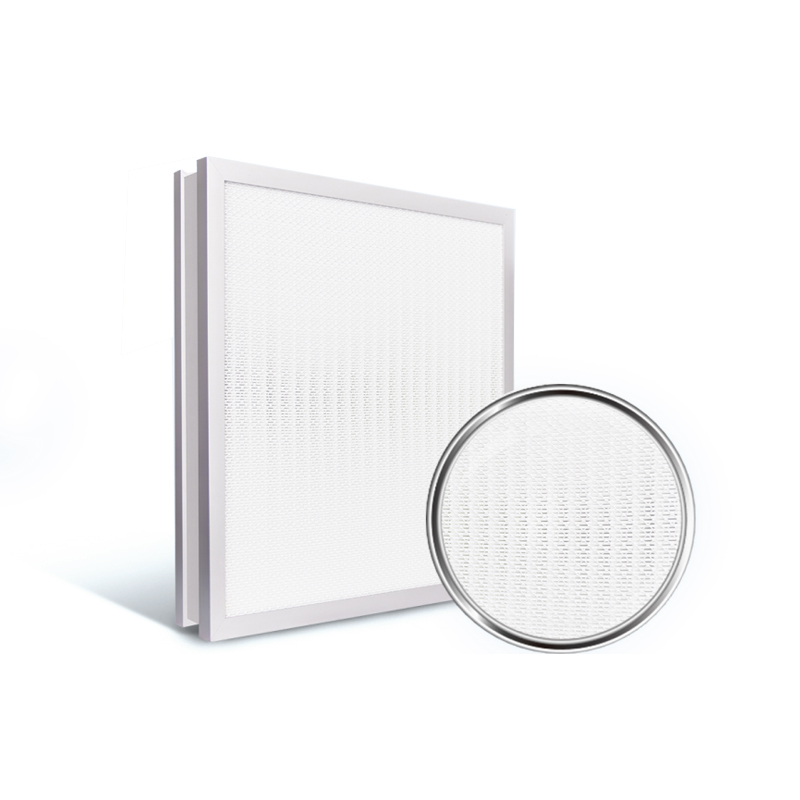
The Oltaven single/double flange medium efficiency filter is a finished filter assembled from high-performance glass fibre media in an anodized aluminium frame. It captures fine particles at E11 or E12 efficiency (EN 1822) and is used in cleanrooms, HVAC systems and FFU units. It is built for facility engineers, OEMs and contractors who need reliable particle control in pharmaceutical, electronics, healthcare and industrial settings.
Filter media sets the upper limit on efficiency, but the finished filter’s performance is determined by how that media is pleated, framed and sealed. At Oltaven, we sell finished filters, not just media. The same glass fibre paper can become a high-capacity filter or a high-resistance one depending on the number of pleats, the pleat depth and the sealing method. Our single/double flange design ensures a tight fit in the duct, preventing air bypass that would otherwise reduce overall efficiency.
Pleating increases the media area within a given frame size. More pleats mean lower face velocity and lower resistance, but pleats that are too tight can restrict airflow and trap dust unevenly. We optimise pleat geometry for each filter size to balance efficiency, pressure drop and dust holding capacity. The frame, whether single or double flange, provides structural rigidity and a sealing surface. The anodized aluminium profile is lightweight and corrosion-resistant, and the flange design creates a mechanical seal against the filter housing, minimising leakage.
Three factors determine how a finished filter performs in service: media choice, pleat and frame design, and sealing integrity. The glass fibre media we use is selected for high efficiency and consistent fibre distribution. For E11 and E12 grades, the media is tested to EN 1822 to ensure it meets the specified particle capture rate.
Pleat count and depth affect resistance and capacity. A filter with more pleats has a larger media area, which lowers air velocity through the media and reduces pressure drop. However, very tight pleats can increase resistance and reduce dust holding capacity because dust collects on the surface rather than penetrating the media. Our engineers balance these factors for each standard size, such as 287 × 592 × 88 mm (rated airflow 1000 m³/h for E11, 500 m³/h for E12) and 592 × 592 × 88 mm (2000 m³/h for E11, 1000 m³/h for E12).
The frame and flange design also matter. The single flange is suitable for standard duct connections, offering easy installation and cost efficiency. The double flange provides sealing on both the upstream and downstream sides, which is beneficial in applications requiring low leakage, such as pharmaceutical cleanrooms or high-pressure-drop systems. The anodized aluminium frame resists corrosion and maintains structural integrity under vibration and airflow.
Sealing is critical. Our filters are sealed to prevent air bypass between the media pack and the frame. This ensures that all air passes through the media, maintaining the rated efficiency. The combination of media, pleating, frame and sealing is what makes a finished filter reliable, not just the media alone.
Oltaven single/double flange medium efficiency filters are used in a wide range of environments where fine particle control is required. They serve as prefilters or final filters in commercial HVAC systems, protecting downstream HEPA filters and extending their service life. In semiconductor and microelectronics manufacturing, they help maintain cleanroom conditions by removing particles that could damage sensitive components. Hospitals and cleanrooms rely on them for operating theatres and isolation rooms, where air quality is critical. The pharmaceutical and food processing industries use these filters to meet hygiene standards and prevent contamination. Automotive and machinery manufacturing plants employ them in paint booths and clean assembly areas. Data centres and energy storage facilities use them to protect cooling equipment from dust and particulate matter. The single flange version is common in standard ducted systems, while the double flange version is preferred for critical applications requiring enhanced sealing.
| Item | Detail |
|---|---|
| Product name | Single/Double Flange Medium & HEPA Filter |
| Filter class (EN 1822) | E11 (sub-HEPA) / E12 (HEPA) |
| Media | High-flux ultra-fine glass fibre filter paper |
| Frame | Anodized aluminium alloy profile |
| Core applications | Pharmaceutical/electronics cleanrooms, hospital operating theatres, HVAC terminal units, FFU (fan filter units) |
| Standard sizes and rated airflow (W × H × D) | 287 × 592 × 88 mm (E11 rated airflow 1000 m³/h; E12 rated airflow 500 m³/h) 592 × 592 × 88 mm (E11 rated airflow 2000 m³/h; E12 rated airflow 1000 m³/h) |
| Customisation (OEM/ODM) | Custom flange dimensions, non-standard airflow and special sizes available. Supported by CNAS testing centre and ISO 9001/IATF 16949 certification. |
Oltaven is an OEM/ODM filter manufacturer with over 20 years of experience and more than 1,000 developed filter solutions. Our 50,000 m² plant in Zhongshan, Guangdong, includes six cleanrooms totalling 20,000 m². Our in-house laboratory is CNAS-accredited and can issue test reports for efficiency, dust holding capacity and resistance. We are certified to IATF 16949 (2024) and hold ISO 9001, ISO 14001 and ISO 45001. Our products comply with REACH and RoHS, and we can provide compliance documentation. We have been exporting to Europe, the US, Japan and Korea for over 20 years.
To receive a tailored proposal for your application, please provide the following details: your device or vehicle model (if applicable), the required filter size or a drawing, the airflow or water flow rate, the operating conditions (temperature, humidity, contaminants), and the estimated quantity. Our team will respond with a specification and quotation. Contact us to begin.
Resistance depends on the media area and pleat geometry. A filter with more pleats has a larger media area, which lowers face velocity and reduces pressure drop. However, pleats that are too tight can increase resistance. Our filters are designed to balance pleat count and depth for optimal airflow and efficiency.
An OEM project begins with your inquiry. Share your device or system model, required filter size or drawing, airflow or water flow rate, operating conditions and estimated quantity. Our engineers will review your requirements and propose a filter specification, followed by a sample for your validation.
The filter is available in E11 (sub-HEPA) and E12 (HEPA) efficiency classes according to EN 1822. E11 filters provide high efficiency for fine particles, while E12 filters offer even higher capture rates for critical applications. The appropriate class depends on your cleanliness requirements and the particles you need to remove.
Yes, we offer full customisation of flange dimensions, non-standard airflow and special sizes. You can choose between single and double flange designs, and we can adapt the frame and media to your specific requirements. Our team will work with you to develop a solution that fits your application.
For standard sizes, the MOQ is typically 50–100 pieces. Custom sizes usually require 100–200 pieces, but we can be flexible for sample orders. Lead time is 7–15 days for stock items and 25–35 days for custom orders, depending on complexity and quantity.
The replacement interval depends on operating conditions and the filter’s dust holding capacity. We recommend replacing the filter when the pressure drop reaches twice the initial resistance or 450 Pa, whichever comes first. Under typical conditions, this may be every 6–12 months. We can provide differential pressure monitoring advice to optimise change-out schedules.
Yes, we can provide samples for your evaluation. Sample lead time is typically 7–15 days. We can also supply test data from our CNAS-accredited laboratory to help you verify performance. Please contact us with your specifications to request a sample.
Our filters are manufactured in a facility certified to IATF 16949 (2024), ISO 9001, ISO 14001 and ISO 45001. They comply with REACH and RoHS, and we can provide compliance documentation. Our CNAS-accredited lab issues test reports for efficiency, resistance and dust holding capacity.