
AR
اتصل بنا This Oltaven coffee machine filter cartridge is a replacement water filter designed to fit KitchenAid KCM5WFP coffee makers. It reduces chlorine, sediment, and scale-forming minerals from…
FILTER MEDIA / ROLLS · SHEETS · DIE-CUT
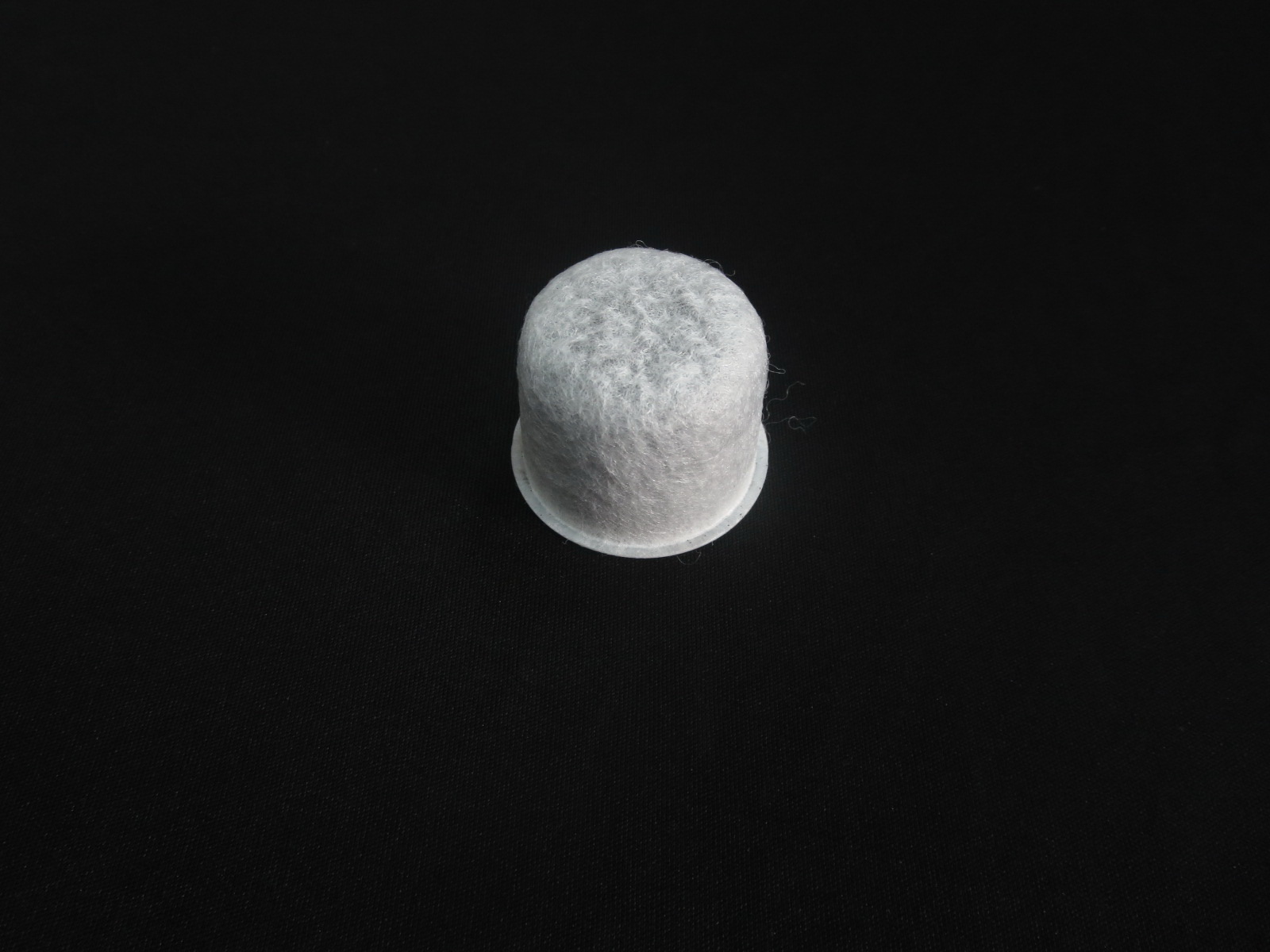
This Oltaven coffee machine filter cartridge is a replacement water filter designed to fit KitchenAid KCM5WFP coffee makers. It reduces chlorine, sediment, and scale-forming minerals from tap water, helping to protect the appliance and support consistent coffee flavor. It is intended for households, offices, and foodservice operators using compatible KitchenAid models, as well as for brands seeking OEM/ODM water filter production.
The performance of any water filter is decided long before the cartridge reaches a coffee machine. It begins with the filter media—in this case, a combination of high-quality coconut-shell activated carbon and food-grade ion exchange resin. The activated carbon adsorbs chlorine, off-tastes, and volatile organic compounds, while the ion exchange resin captures calcium and magnesium ions that cause scale. Yet the media alone does not make a filter. How that media is pleated, shaped, and assembled into a cartridge determines the flow path, the contact time between water and media, and the mechanical strength of the final product. At Oltaven, we sell finished filters, not just media. Every cartridge is engineered as a system: the carbon block or granular bed is formed to a precise density, the housing is molded to maintain structural integrity under pressure, and the sealing surfaces are designed to prevent bypass. This integrated approach ensures that the filter delivers the intended efficiency, resistance, and capacity when installed in a coffee machine.
Three interrelated factors govern how a finished filter performs: filtration efficiency, flow resistance, and contaminant capacity. Efficiency is primarily a function of media selection and pore structure. Coconut-shell activated carbon offers a high surface area and a microporous structure that is effective for chlorine reduction, while ion exchange resin beads are chosen for their affinity for hardness ions. The forming process—whether the carbon is pressed into a block or packed as granules—affects the contact time and the uniformity of the media bed. A densely formed block can improve mechanical filtration and reduce channeling, but it may also increase pressure drop.
Flow resistance, or pressure drop, is influenced by the media’s permeability, the thickness of the filter bed, and the design of the inlet and outlet paths. In a coffee machine, the water pump has limited pressure, so excessive resistance can reduce flow rate and alter brewing parameters. Oltaven balances these factors by adjusting the media formulation and the internal geometry of the cartridge. The housing and end caps are designed to distribute water evenly across the media surface, avoiding localized high-velocity zones that could lead to premature breakthrough.
Capacity—the volume of water a filter can treat before exhaustion—depends on the amount of active media and the concentration of contaminants in the feed water. The filter life of approximately 250 liters or 2–3 months is based on typical municipal water quality and average daily use. Higher hardness or higher chlorine levels will reduce effective capacity. The forming and sealing of the cartridge also affect capacity by preventing water from bypassing the media; a reliable seal ensures that all water contacts the treatment media, so the rated capacity is actually usable.
In summary, the finished filter’s performance is not just a matter of choosing a good carbon or resin. It is the result of matching media characteristics with forming techniques and robust sealing. Oltaven’s engineering team works on all three aspects to deliver cartridges that meet the specified efficiency, resistance, and capacity targets.
This filter cartridge is designed for use in KitchenAid KCM5WFP coffee machines, but its underlying technology is applicable across a range of coffee brewing equipment. It is suitable for:
In each application, the goal is to deliver water that is free of undesirable tastes and scale-forming minerals, while preserving minerals that contribute to a pleasant cup. The filter operates with cold water only, within a pressure range of 20–120 psi and a temperature range of 2°C to 38°C.
| Item | Detail |
|---|---|
| Filtration Media | High-quality coconut-shell activated carbon and food-grade ion exchange resin |
| Micron Rating | Fine microporous interception; effectively captures sediment, rust, and other large particles |
| Filter Life | Approximately 250 liters or 2–3 months (depending on local water quality and usage frequency) |
| Operating Pressure | 20–120 psi (approximately 1.4–8.3 bar) |
| Operating Temperature | 2°C–38°C (cold water filtration only) |
| Applications | Automatic coffee machines, semi-automatic espresso machines, commercial coffee machine water softening, OEM water filter cartridge customization |
| Quality Certification System | Production complies with ISO 9001/14001, IATF16949, medical supplies GMP standard, CNAS national-level testing certification |
Oltaven brings over 20 years of experience in filtration product development and manufacturing, with more than 1,000 filtration solutions developed to date. Our OEM/ODM capabilities cover everything from media selection and cartridge design to packaging and labeling, allowing us to tailor products to specific appliance models and market requirements.
Our production base in Zhongshan, Guangdong, China, spans 50,000 m², including six cleanrooms totaling 20,000 m². Coffee machine filter cartridges are assembled and packaged in these controlled environments to prevent contamination. We operate a CNAS-accredited laboratory capable of testing filtration efficiency, contaminant capacity, and flow resistance, among other parameters. Our quality management system is certified to ISO 9001, ISO 14001, and ISO 45001, and we are also IATF 16949 certified (obtained in 2024). Products can be supplied with documentation confirming compliance with REACH and RoHS regulations. With multiple automated production lines, we can achieve monthly output in the millions of pieces, supporting both standard and custom orders. All products undergo IQC, IPQC, and OQC inspection throughout the manufacturing process.
For brands and distributors interested in custom filter cartridges, we follow a structured development process:
This workflow ensures that the final product matches your specifications and performs reliably in the field.
Whether you need a replacement filter for a specific coffee machine model or a fully customized OEM/ODM solution, Oltaven is ready to assist. To help us respond quickly, please provide the following details when you contact us:
Our team will review your inquiry and propose a suitable filter solution. We look forward to partnering with you.
Filters of identical external dimensions can have different flow resistance because the internal media, its forming method, and the flow path design vary. A densely packed carbon block may offer finer filtration but higher pressure drop, while a more open structure reduces resistance at the expense of some efficiency. Oltaven balances these factors by selecting media and designing the cartridge geometry to meet the target resistance for each application.
An OEM project begins with your inquiry, where you share the device model, required dimensions, filtration goals, and estimated quantity. Our engineering team assesses feasibility and proposes a media formulation and cartridge design, followed by sample development and testing. Once samples are approved, we proceed to production under our quality control protocols.
This cartridge uses coconut-shell activated carbon and food-grade ion exchange resin to reduce chlorine, sediment, and scale-forming minerals. The media are selected for high adsorption capacity, and the forming process ensures uniform contact with water. While we do not quote a single efficiency percentage, our CNAS laboratory tests each formulation for chlorine reduction and capacity according to relevant standards.
Yes, we provide free samples (typically 2–5 units) to B2B customers for evaluation. Samples are usually shipped within 3–7 days, with international express costs borne by the customer. Custom samples with your logo or specific design may incur a sample fee, which is refundable upon mass production.
For standard compatible models, the MOQ is 5,000 pieces, with lead times of 15–20 days for stock or small batch orders. For OEM customizations, we recommend an MOQ of 10,000 pieces, and mass production typically takes 25–30 days after sample approval, including mold and packaging development.
Under typical water quality and usage conditions, the filter should be replaced every 2–3 months or after treating approximately 250 liters of water. If your water has higher hardness or chlorine levels, you may need to replace it more frequently. Regular replacement ensures consistent water quality and protects your coffee machine from scale buildup.
Yes, we have experience developing compatible filters for many major coffee machine brands, including Keurig, Breville, De'Longhi, Philips, Jura, Nespresso, and KitchenAid. Our engineering team can reverse-engineer from a sample or model number to match flow, pressure drop, and fit. This allows brands to quickly enter the aftermarket consumables market.
Our production facility is certified to ISO 9001, ISO 14001, ISO 45001, and IATF 16949 (obtained in 2024), and we follow medical supplies GMP standards. Our CNAS-accredited laboratory supports testing and documentation. Products can be supplied with REACH and RoHS compliance documents, and we can also arrange third-party testing upon request.