
AR
اتصل بنا This conical HEPA filter element is a finished replacement filter for handheld cordless vacuums, robot vacuums, mattress mite removers, wet-dry cleaners and compact car vacuums. It captures…
FILTER MEDIA / ROLLS · SHEETS · DIE-CUT
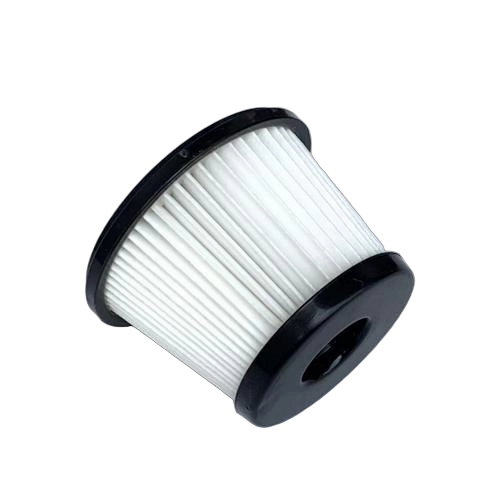
This conical HEPA filter element is a finished replacement filter for handheld cordless vacuums, robot vacuums, mattress mite removers, wet-dry cleaners and compact car vacuums. It captures fine dust (PM2.5), dust mites, pollen and hair from the airstream before air leaves the dust cup, helping stop exhaust re-pollution. It is made by Oltaven in Zhongshan, Guangdong, China, for brands and buyers who need a filter matched to their own machine rather than a catalogue part.
Filter media sets the ceiling on performance, but it does not deliver that performance on its own. A sheet of high-precision PTFE membrane, composite PP meltblown or antibacterial-treated filter paper is flat and fragile. The finished filter is what the vacuum actually breathes through, and its efficiency, resistance and dust capacity are decided by how the media is pleated, framed and sealed.
Pleating is the first step. Folding the media into a cone-shaped pack puts a large filter area into a small space, and the number and depth of pleats decide how much air the element can pass at a given resistance. Too few pleats and the filter chokes the motor; too many in the wrong geometry and the pleats collapse in service. Because this element is conical, the pleat layout must also follow the dust cup's shape so the incoming dirt-laden air reaches the whole surface, not just the tip.
Framing and sealing are the second step. Oltaven supplies eco-friendly injection-moulded frames and rubber sealing-ring edge treatment, which hold the pleat pack in shape and close the gap between filter and housing. A perfect media sheet in a loose frame leaks dust around its edges. That is why we sell finished filters: the value is in the combination of material grade, pleat design, frame and seal, each matched to one machine's airflow path.
Efficiency comes from the media grade and from how completely the air is forced through it. The PTFE membrane's fine pores block particles at H11–H13 level, with filtration efficiency of ≥99.95% for 0.3 μm particles. That figure only holds if the pleat pack and the rubber-sealed frame leave no bypass path, so the finished element, not the raw roll, is what carries the rating.
Resistance is decided by media porosity plus pleat area. The high-porosity, breathable design keeps running resistance very low, which protects the motor from overheating and helps battery runtime. Airflow through a small area is always harder than through a large one, so the conical pleat count matters as much as the material choice.
Capacity is the third variable. A filter with high dust holding capacity takes longer to load up, so suction stays strong between changes. The pleat geometry, the depth of the folds and the frame that keeps them open all determine how much dust the element can store before resistance climbs.
Two filters of identical outer size can therefore behave differently. Same paper, different pleat count, different frame tolerance, different seal, different result. That is why Oltaven develops each element against the customer's own airflow path and dust cup rather than picking the nearest stock size.
The element is used in handheld cordless vacuums, smart robot vacuums, mattress and mite-removal appliances, hard-floor wet-dry cleaners and compact car vacuums. In each case the conical shape fits the machine's dust cup, and the low-resistance media keeps suction and battery life where the product team intended.
Two media routes cover different product positions. A washable PTFE-coated element suits buyers who want a reusable filter and a lower running cost for the user. A disposable HEPA element suits buyers who prioritise filtration precision. Both are built on the same custom frame and seal platform, so a brand can offer either, or both, across one machine range.
| Item | Detail |
|---|---|
| Product name | Vacuum cleaner filter element / robot vacuum filter |
| Core filtration media | High-precision PTFE (microporous PTFE membrane) / composite PP (polypropylene meltblown) / antibacterial-treated filter paper |
| Core purification function | Strong capture of fine particles in the dust cup (PM2.5), dust mites, pollen, hair and similar, preventing exhaust re-pollution |
| Physical and airflow characteristics | High-porosity, breathable design with very low running resistance and high dust holding capacity; helps prevent motor overheating and improves battery runtime |
| Main end applications | Handheld cordless vacuums, smart robot vacuums, mattress mite-removal appliances, wet-dry cleaners, compact car vacuums |
| Frame and size customisation | 100% flexible contract manufacturing to the device's airflow path and dust cup dimensions; eco-friendly injection-moulded frame and rubber sealing-ring edge treatment for airtight, dust-tight closure |
| Manufacturing and quality systems | 50,000 m² production base and CNAS-accredited testing centre; ISO 9001, ISO 14001 and IATF 16949 quality management systems |
Oltaven builds filters as an OEM/ODM partner, and the project starts with the machine, not with a stock list. Over more than 20 years of filter development and manufacturing, the company has accumulated more than 1,000 developed filtration solutions, and the conical vacuum element is one of the formats that experience supports.
Production runs in a 50,000 m² plant in Zhongshan, Guangdong, China, including six cleanrooms totalling 20,000 m², so HEPA elements are assembled in a controlled environment rather than on an open floor. A CNAS-accredited laboratory tests filtration efficiency, dust holding capacity and resistance, and can issue reports on those results.
Quality management is certified to IATF 16949 (achieved in 2024) as well as ISO 9001, ISO 14001 and ISO 45001, and products meet REACH and RoHS environmental requirements with compliance documents available. The company has exported to Europe, the United States, Japan and Korea for more than 20 years, and multiple automated production lines support monthly output in the millions of pieces.
To quote a conical vacuum filter accurately, we need five things: your device or vehicle model, the size or a drawing, the airflow or water flow the element must handle, the operating conditions (dust load, humidity, washable or disposable), and the quantity you expect per order and per year. Send them through the contact page and our team will come back with a proposal and sample plan. We welcome long-term OEM/ODM partnerships and treat each new filter as a joint development, from first drawing to repeat production.
Resistance depends on how much filter area the pleat pack exposes and how porous the media is, not on the outer dimensions. Two elements can share a footprint while one has more, deeper pleats and a higher-porosity layer, so it passes the same airflow at lower resistance. Oltaven tunes pleat count and media grade together for each machine's airflow path.
The element reaches H11–H13 grade, with filtration efficiency of ≥99.95% for 0.3 μm particles. That captures fine dust (PM2.5), pollen, dust mites and hair before air leaves the dust cup. The figure applies to the finished, sealed filter, because bypass leakage around the frame would reduce it.
Yes. Oltaven develops the element from your drawing, sample or machine model, matching the conical size, pleat layout, frame and rubber sealing ring to the dust cup. We can also supply eco-friendly injection-moulded frames and sealed edges for airtight closure. Send the model and dimensions to start.
Sampling follows the requirement review: you provide the device model, size or drawing, airflow and operating conditions, and we build a matched sample for fit and airflow testing. The CNAS laboratory can supply efficiency, resistance and dust-holding data with it. Quote terms depend on the confirmed specification and quantity.
MOQ and lead time are confirmed per project once media, frame and packaging are fixed, because a custom conical element is tooled to your machine. Multiple automated lines support monthly output in the millions of pieces, so volume orders can be scheduled. Ask for current figures with your inquiry.
A washable PTFE-coated version supports repeated cleaning, while a disposable HEPA version is replaced when resistance rises. Replacement interval depends on use frequency and dust load, so agree it against your test data. Both versions are built on the same custom frame platform.
It starts with your device model, size or drawing, airflow, operating conditions and expected quantity. Oltaven then proposes media grade, pleat design, frame and seal, and produces a sample for validation. After sign-off, tooling, cleanroom assembly and IQC/IPQC/OQC inspection lead into mass production.
The plant is certified to ISO 9001, ISO 14001, ISO 45001 and IATF 16949, and products meet REACH and RoHS requirements with compliance documents available. Testing runs through a CNAS-accredited laboratory. Tell us your target market in the inquiry so the right documents are prepared.