AR
اتصل بنا This cylindrical activated carbon filter is a finished filter element built for gas-phase adsorption in air purifiers, fresh-air systems, automotive cabin filters, central air handling…
FILTER MEDIA / ROLLS · SHEETS · DIE-CUT
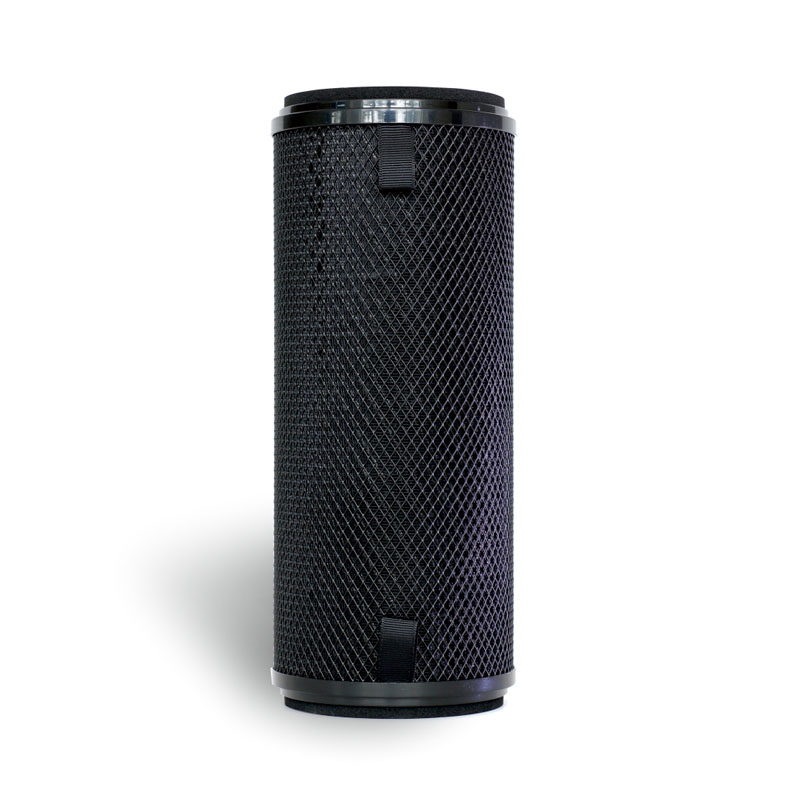
This cylindrical activated carbon filter is a finished filter element built for gas-phase adsorption in air purifiers, fresh-air systems, automotive cabin filters, central air handling units and industrial odour control. It removes formaldehyde, benzene, ammonia, TVOCs and a wide range of odours from the air stream. It is aimed at appliance brands, HVAC integrators, automotive suppliers and industrial buyers who need a filter matched to their device rather than a generic media roll. The filter is manufactured by Oltaven in Zhongshan, Guangdong, China.
Activated carbon works by trapping gas molecules in its internal pore structure. The raw material matters: a high-iodine-value carbon offers more adsorption sites per gram. But the finished filter is not simply a container of carbon. The way the carbon is held, the shape it is formed into, and the way air is directed through it determine how much of that capacity the device can actually use.
Oltaven sells finished filters, not loose media. That means the pleating, forming, framing and sealing steps are part of the product design. A cylindrical format, for example, lets air pass through the carbon bed from the outside in or inside out, depending on the housing. The end caps and the outer wrap keep the carbon in place and force the air through the bed rather than around it. The result is a drop-in part that delivers predictable adsorption, resistance and service life in the customer's device.
Three outcomes matter to a device designer: efficiency (how much gas is removed), resistance (how hard the fan has to work) and capacity (how long the filter lasts). All three are decided by choices made during forming and assembly.
Efficiency depends on the carbon type, the amount of carbon, and the contact time between air and carbon. A deeper carbon bed or a slower face velocity gives molecules more time to reach the pore surface. The forming step fixes the bed depth and the airflow path, so it directly sets the achievable efficiency for a given carbon.
Resistance comes from the carbon bed, the retaining layers and the geometry of the air path. A cylindrical filter can spread the airflow over a large surface area, which keeps face velocity low and resistance down. The framing and sealing must be tight enough to prevent bypass, but not so restrictive that they add unnecessary pressure drop. Low resistance supports the device's energy efficiency.
Capacity is the total amount of gas the filter can hold before breakthrough. It is set by the carbon mass and its iodine value, and by how evenly the air flows through the bed. If the forming process leaves dead zones or channels, some carbon is never used. Good sealing and uniform packing let the full carbon charge work, which is why the finished build matters as much as the media specification.
The cylindrical activated carbon filter is used where odours and gaseous pollutants need to be removed from an air stream. Typical applications include:
Because the filter is custom-made, the same cylindrical concept can be sized and configured for different housings, airflow rates and target gases.
| Item | Detail |
|---|---|
| Core filtration material | High-iodine-value activated carbon |
| Product shape / specification | Cylindrical; fully customizable to customer drawings or requirements |
| Main purification performance | High-efficiency adsorption and removal of formaldehyde, benzene, ammonia, TVOC and various odours |
| Core application scenarios | Air purifiers, fresh-air system pre-filtration, automotive cabin filters, central air conditioning systems, industrial exhaust odour control |
| Manufacturer brand | Oltaven (Zhongshan, Guangdong, China) |
Customisation options include dimensions, carbon type and weight, end-cap material, functional coatings and branding. Please provide your device model, drawing or size, airflow requirement and operating conditions so we can propose a specification.
Oltaven is an OEM/ODM filter manufacturer with more than 20 years of experience and over 1,000 developed filtration solutions. Our 50,000 m² plant includes six cleanrooms totalling 20,000 m², and our CNAS-accredited laboratory can issue test reports for filtration efficiency, dust holding capacity and resistance. We are certified to IATF 16949 (2024) and hold ISO 9001, ISO 14001 and ISO 45001 system certifications. Products comply with REACH and RoHS, and we can provide the relevant compliance documents. Our address is Zhongshan, Guangdong, China.
Starting a custom cylindrical activated carbon filter with Oltaven follows a clear sequence:
To receive a quotation or a technical proposal, please tell us:
Send these details through our contact page. Our team will respond with a specification proposal and a quotation. We welcome long-term OEM/ODM partnerships and are glad to work with you from the first sample to series production.
Resistance depends on the carbon bed depth, the airflow path and how tightly the filter is sealed. Two filters with the same outside dimensions can have different internal geometry, so the air may face a deeper bed or a narrower path in one of them. Oltaven designs the forming and sealing to keep resistance low while preventing bypass.
It starts with your requirement: device model, drawing or sample, target airflow, gases to remove and available space. Oltaven reviews the requirement, proposes a carbon type and build, and produces samples for your validation. After sample approval, bulk production follows with IQC, IPQC and OQC checks.
Efficiency is not a single fixed number because it depends on the carbon type, bed depth and contact time. The filter uses high-iodine-value activated carbon and is designed to adsorb formaldehyde, benzene, ammonia, TVOC and odours. For a specific device, we can propose a specification and provide test data from our CNAS-accredited laboratory.
Yes. The cylindrical format is fully customizable. We can adjust dimensions, carbon type and weight, end-cap material, functional coatings and branding to match your housing and performance targets. Please provide a drawing or sample for a 1:1 development.
Standard models typically have an MOQ of 500–1,000 pcs, while custom models generally require 2,000–3,000 pcs depending on complexity. Standard samples are usually free with freight collect; custom samples may incur a fee that is deductible from a bulk order. Lead time is 3–7 days for standard stock items and 15–25 days for custom production after sample confirmation.
Under normal operating conditions, the filter life is 6–12 months, depending on pollutant concentration and airflow. A higher concentration or higher airflow will shorten the service life. We recommend monitoring odour breakthrough or following the device manufacturer's replacement schedule.
Oltaven holds ISO 9001, ISO 14001, ISO 45001 and IATF 16949 certifications, and products comply with REACH and RoHS. We can provide compliance documents such as MSDS and RoHS/REACH declarations to support your export and customs needs.
Please send your device model, required size or drawing, airflow, operating conditions and estimated quantity through our contact page. Our team will respond with a specification proposal and quotation. We look forward to supporting your project from sample to series production.