
AR
اتصل بنا A dust-removal cabin air filter from Oltaven is a finished automotive air conditioner filter that combines high-precision HEPA filtration media with high-iodine-value coconut-shell granular…
FILTER MEDIA / ROLLS · SHEETS · DIE-CUT
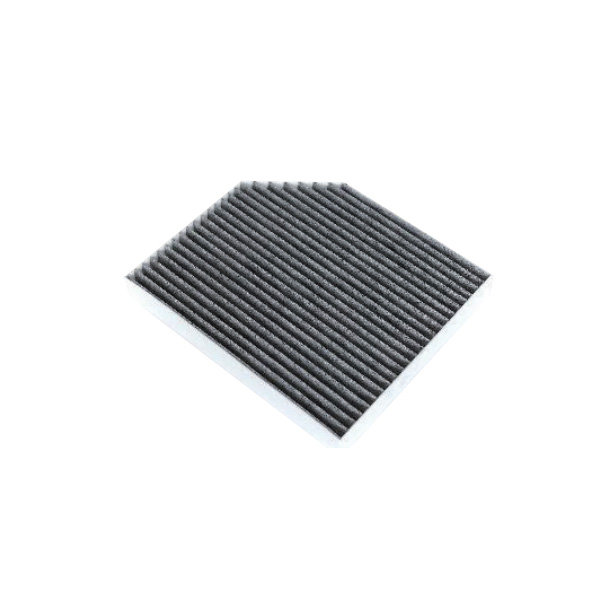
A dust-removal cabin air filter from Oltaven is a finished automotive air conditioner filter that combines high-precision HEPA filtration media with high-iodine-value coconut-shell granular activated carbon. It captures PM2.5 particles and dust from the air entering the cabin and adsorbs ammonia, sulphides and exhaust VOCs. It is made for passenger cars, coaches, heavy trucks and construction machinery, and for brands and distributors who need full-vehicle OEM/ODM customisation rather than loose media.
Media is where filtration starts, but it is not where it ends. A roll of HEPA-grade material and a bag of coconut-shell carbon are only raw inputs. The finished cabin filter is the result of how those inputs are pleated, stacked, framed and sealed, and those steps decide the efficiency, resistance and dust-holding capacity the driver actually experiences.
Pleating is the clearest example. Folding the media packs a large filtration area into a small panel that fits the HVAC duct. The number of pleats and the depth of each fold set how much media face the airflow meets, and therefore how the filter balances low resistance against high capacity. A shallow, widely spaced pleat pack may flow easily at first but holds less dust; a denser pack stores more dust before loading but must be formed with care so the folds do not collapse or block.
Framing gives the pack its shape and its fit in the vehicle. The frame keeps the pleats evenly spaced, holds the panel square and lets it seat correctly in the air-conditioning duct. Sealing closes the edges so air cannot bypass the media and carry dust around it. A well-formed filter therefore delivers its rated performance because media, pleat geometry, frame and seal work together, not because of any single material.
Efficiency describes how much of the dust and PM2.5 reaching the filter is captured. It depends on the media grade and on how consistently the media is formed into the panel. The multi-layer composite used in this cabin filter reaches a filtration efficiency of ≥95% for PM2.5, pollen and dust, and ≥99% for PM10 particles.
The high-iodine-value coconut-shell granular activated carbon is the functional layer behind odour control. Its high iodine value indicates a developed pore structure, which is what allows it to adsorb ammonia, sulphides and exhaust VOCs rather than merely mask them.
Low resistance keeps the air-conditioning blower working as designed. The pleated forming process gives this filter good airflow characteristics and low operating resistance, so cabin ventilation is not noticeably reduced.
Capacity is the amount of dust a filter can hold before resistance rises too far. It is governed by the total media area created by pleating and by how evenly dust is distributed across the pleats. This filter is built for high dust-holding capacity and a long service life, which is why replacement intervals are measured in distance and months rather than weeks.
This dust-removal cabin filter is used in the air-conditioning and ventilation systems of passenger cars, including saloons, SUVs and MPVs, as well as commercial coaches, heavy trucks and construction machinery. In each case the same principle applies: the filter protects the cabin air supply from dust and PM2.5 and reduces exhaust odours and VOCs entering through the HVAC system.
Because duct dimensions differ from one vehicle platform to another, the filter is supplied as a custom-formed part. Length, width, thickness and pleat count can be set to the original equipment air duct requirements, and the media grade can be chosen for standard dust removal, PM2.5 high-efficiency duty, activated-carbon composite duty or HEPA duty, with paper, plastic or metal frames.
| Item | Detail |
|---|---|
| Product name | Automotive cabin air filter / automotive air conditioner filter (dust removal) |
| Core construction | Dual-effect composite: high-precision HEPA filtration media plus high-iodine-value coconut-shell granular activated carbon |
| Core purification performance | High-efficiency interception of PM2.5 particles and dust; targeted adsorption of ammonia, sulphides and exhaust VOCs |
| Physical and flow characteristics | Good airflow characteristics, low operating resistance, high dust-holding capacity and long service life |
| Main applications | Air-conditioning and ventilation systems of passenger cars (saloons, SUVs, MPVs), commercial coaches, heavy trucks and construction machinery |
| Size customisation | 100% OEM/ODM customisation for all vehicle models; any length, width, thickness and pleat count can be produced to the original equipment air duct requirements |
| Quality system | 50,000 m² plant; IATF 16949 automotive quality management system; factory quality assured by a national CNAS testing centre |
Oltaven is a filter manufacturer based in Zhongshan, Guangdong, China, with more than 20 years of filtration product development and manufacturing experience and more than 20 years of continuous export to Europe, the United States, Japan and Korea. We support OEM/ODM projects covering size, structure, media grade, frame material, logo and packaging, and have developed more than 1,000 filtration solutions for customers worldwide.
The production base covers 50,000 m², including six cleanrooms with a combined area of 20,000 m². A self-built laboratory is accredited by CNAS and can issue test reports on filtration efficiency, dust-holding capacity and resistance. The company obtained IATF 16949 automotive quality management system certification in 2024 and holds ISO 9001, ISO 14001 and ISO 45001 system certifications. Products meet the REACH and RoHS environmental requirements, and compliance documents can be supplied with shipments.
Quality control runs through the whole process: incoming inspection (IQC), in-process inspection (IPQC) and outgoing inspection (OQC). Multiple automated production lines support a monthly capacity of several million pieces.
If you are sourcing a cabin air filter for a vehicle platform, a parts range or a private label, the fastest route is to tell us the device or vehicle model, the size or drawing, the required airflow or application conditions and the quantity you expect. Our team can then confirm the media grade, pleat geometry and frame that suit your duct, and return a quotation and sampling plan.
Two filters can share the same external dimensions but differ in pleat count, pleat depth and media grade. More media area spread through careful pleating lowers face velocity and resistance, while a denser or thicker media increases capture but may raise resistance. Oltaven forms each panel so that low operating resistance and high dust-holding capacity are balanced for the vehicle duct.
It starts with your vehicle model, a drawing or the required dimensions, the expected airflow or application conditions and the quantity. We then confirm size, pleat count, media grade, frame material and packaging, and develop a sample accordingly. For special vehicle requirements, sample development can be completed within 7-10 working days.
The multi-layer composite construction reaches a filtration efficiency of ≥95% for PM2.5, pollen and dust, and ≥99% for PM10 particles. The activated carbon layer additionally adsorbs ammonia, sulphides and exhaust VOCs. Efficiency figures refer to this product as tested in our CNAS-accredited laboratory.
Yes. The filter is 100% open to OEM/ODM customisation for all vehicle models. Any length, width, thickness and pleat count can be produced to the original equipment air duct requirements, and you can choose standard dust removal, PM2.5 high-efficiency, activated-carbon composite or HEPA media grades with paper, plastic or metal frames.
The MOQ for standard specifications is usually 1,000-2,000 pieces; customised versions generally start at 5,000 pieces depending on tooling. Free samples are available for standard stock items with freight paid by the customer, while custom samples carry a small development fee that can be credited against the first order. Standard lead time is 15-25 days and customised orders 30-45 days including tooling.
Under normal use, replacement is recommended every 10,000-15,000 km or every 6-12 months, depending on local air quality and usage conditions. In dusty or heavily polluted areas the interval should be shortened. The filter is tested for dust-holding capacity so that it maintains stable filtration and low resistance throughout its service life.
Yes. We support logo printing, individual packaging and colour-box design, along with multilingual instructions, barcodes or QR codes and anti-counterfeit labels. Standard export packing is a PE bag plus colour box plus a five-layer reinforced corrugated carton. Packaging samples are usually completed within 3-5 working days after the design is confirmed.
Send the vehicle model, size or drawing, required airflow or application conditions and expected quantity through our contact page. Our team will confirm the specification and return a quotation and sampling plan. <a href="/en/contact">Start your inquiry here</a>.