
AR
اتصل بنا Oltaven bag filters are finished air filters that capture coarse to fine particles in HVAC and ventilation systems. They are available in efficiency classes from G4 to F9 and use non-woven…
FILTER MEDIA / ROLLS · SHEETS · DIE-CUT
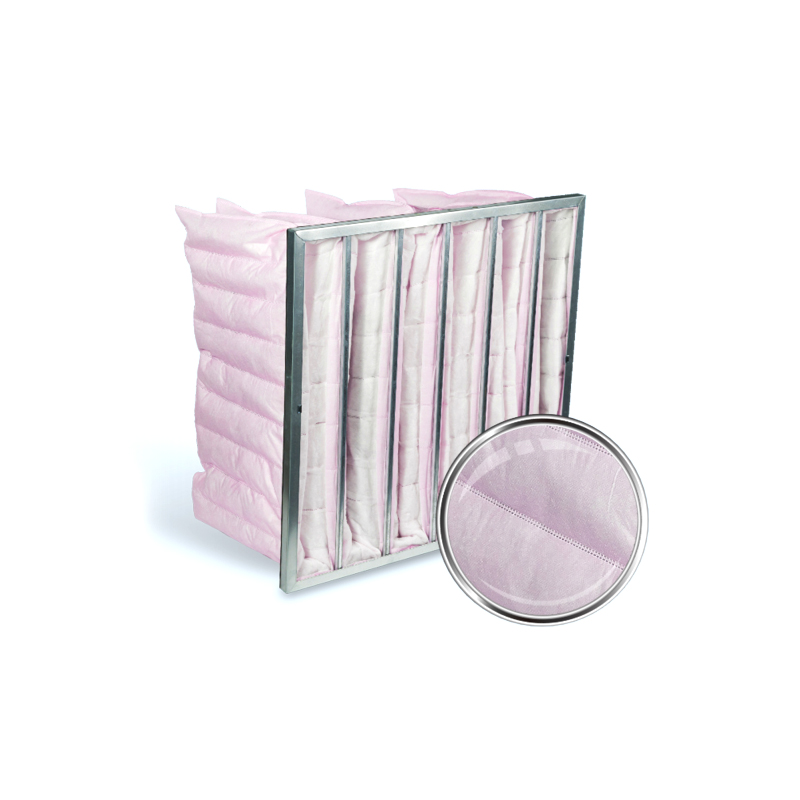
Oltaven bag filters are finished air filters that capture coarse to fine particles in HVAC and ventilation systems. They are available in efficiency classes from G4 to F9 and use non-woven fiber or fiberglass media in aluminum or galvanized frames. Facility managers, HVAC contractors and OEM buyers choose them for central air handling units, cleanroom fresh-air systems, and industrial plant ventilation. Oltaven manufactures the complete filter, not just the media, so media choice, pleating or bag forming, framing and sealing all determine the filter’s efficiency, resistance and dust-holding capacity.
A bag filter starts with the selection of a filter medium. The media sets the achievable efficiency and the initial resistance, but the finished filter’s performance is the result of how that medium is formed and assembled. Oltaven uses high-throughput non-woven fiber or flame-retardant fiberglass media. The media is cut, joined and stitched into a series of bags, and those bags are fixed into a rigid frame. The number of bags, their depth and the frame material are all chosen to match a target airflow and resistance.
Forming matters because a bag that is too shallow or too tightly packed will raise resistance and may reduce airflow. A bag that is too loose may not hold its shape, allowing air to bypass or the bag to collapse at higher velocities. Oltaven’s high-pressure-resistant construction is designed to maintain bag shape at the rated operating velocity of 2.5 m/s. Framing also affects fit: aluminum and galvanized frames are available, and both are selected for compatibility with the holding frame or track in the customer’s air handling unit. Sealing between the media pack and the frame prevents unfiltered air from bypassing the filter.
Because Oltaven sells finished filters, every step from media selection to final assembly is controlled in-house. This means the efficiency, resistance and capacity published for a model are the performance of the finished product, not just the media.
Three performance figures matter most in a bag filter: efficiency, initial resistance and dust-holding capacity. Media choice is the starting point. Non-woven fiber media are typically used for G4 to M6 grades and offer high dust-holding capacity with low resistance. Fiberglass media, including flame-retardant grades, are used where higher efficiency or fire resistance is required, such as F7 to F9. The media’s fiber diameter, thickness and surface treatment influence how efficiently particles are captured and how quickly the filter loads.
Pleating and bag forming increase the media area within a given frame size. More media area lowers the face velocity through the media and therefore reduces resistance, while also increasing the amount of dust the filter can hold before reaching its final resistance. In bag filters, the number and depth of bags determine the effective media area. Oltaven offers standard configurations with 3, 4, 6, 8 or 10 bags in common face sizes, and custom bag counts are available. The depth of the bags also affects resistance and capacity; standard depths include 534 mm (21 in) and 381 mm (15 in), with other depths available on request.
Framing and sealing complete the picture. A rigid aluminum or galvanized frame holds the bags in position and maintains the filter’s dimensions under airflow. Proper sealing between the media and the frame prevents air from bypassing the filter, which would otherwise reduce overall efficiency. Oltaven’s finished filters are assembled so that the media, frame and seal work together as a single unit.
The result is a filter whose efficiency, resistance and capacity are determined by the combination of media, forming and assembly. This is why two filters of the same nominal size can perform differently: the amount of media, the bag geometry and the quality of the seal all vary. Oltaven’s engineering team can help match these variables to the specific airflow and resistance requirements of an application.
Oltaven bag filters are used across a wide range of air-handling systems. In commercial buildings, they serve as pre-filters in central air conditioning and ventilation systems, protecting downstream components and improving indoor air quality. In cleanrooms, they are used in fresh-air systems to provide medium-efficiency filtration ahead of higher-efficiency final filters. Electronics, pharmaceutical and coating plants use them in HVAC filtration systems to control particles that could affect processes or products.
The filters are also suitable for data centers and AI computing facilities, where reliable airflow and dust control are important for cooling equipment. Energy storage facilities use them for pre-filtration and medium-efficiency filtration to protect sensitive equipment. Automotive and machinery manufacturing plants apply them in paint booths and general ventilation. Food and pharmaceutical processing facilities use them as pre-filters and medium-efficiency filters where hygiene and air quality are priorities. Medical and cleanroom-related spaces rely on them for both pre-filtration and medium-efficiency stages.
Because the filters are available from G4 to F9, they can be selected for pre-filter, medium-efficiency or final-filter stages depending on the system design. The high dust-holding capacity helps extend service intervals, and the low initial resistance contributes to energy savings in continuous operation.
| Item | Detail |
|---|---|
| Filter class | G4, M5, M6, F7, F8, F9 (pre-filter to medium-efficiency) |
| Media | High-throughput non-woven fiber or flame-retardant fiberglass |
| Frame material | Aluminum or galvanized steel |
| Rated operating velocity | 2.5 m/s |
| Standard sizes (W × H × D) | 594 × 594 × 534 mm (24×24×21 in) – typically 6, 8 or 10 bags; 594 × 492 × 534 mm (24×20×21 in) – typically 6 or 8 bags; 289 × 594 × 534 mm (12×24×21 in) – typically 3 or 4 bags; other depths such as 381 mm (15 in) are available |
| Typical applications | Central air conditioning pre-filtration in commercial buildings; cleanroom fresh-air systems; HVAC filtration in electronics, pharmaceutical and coating plants |
| Customization | Non-standard sizes and bag counts fully supported based on 20 years of manufacturing experience and a CNAS-accredited testing center |
Oltaven’s OEM/ODM capability is built on more than 20 years of filter development and manufacturing. The company has developed over 1,000 filtration solutions and continues to export to Europe, the United States, Japan and South Korea. This experience supports customers who need custom sizes, bag counts, media grades, frame materials, logos and packaging.
The production base in Zhongshan, Guangdong, China, covers 50,000 m², including six cleanrooms with a combined area of 20,000 m². A CNAS-accredited laboratory allows Oltaven to issue test reports for filtration efficiency, dust-holding capacity and resistance. Quality management is certified to ISO 9001, ISO 14001 and ISO 45001, and in 2024 the company obtained IATF 16949 certification for the automotive industry. Products comply with REACH and RoHS environmental regulations, and compliance documentation is available. These resources support consistent quality and reliable delivery for OEM and project orders.
To discuss a custom bag filter project, please provide the following information: your device or system model, the required size or a drawing, the airflow or face velocity, the operating conditions (such as temperature, humidity and particle loading), and the estimated quantity. Oltaven’s engineering and sales team will respond with a tailored solution. Contact us to start the conversation.
Resistance depends on the media, the amount of media area and the bag geometry. Two filters with the same face dimensions can have different bag counts, bag depths or media types, which change the velocity through the media and therefore the resistance. Oltaven can help select the configuration that meets your resistance target.
An OEM project starts with your requirements: device or system model, size or drawing, airflow, operating conditions and quantity. Oltaven reviews these and provides a technical proposal and quotation. Samples can then be produced for approval before production.
Oltaven bag filters are available in G4, M5, M6, F7, F8 and F9. Lower grades such as G4 are typically used for pre-filtration, while higher grades like F7 to F9 provide medium-efficiency filtration. The grade is determined by the media and construction, and each grade has its own efficiency and resistance profile.
Yes. Oltaven fully supports custom sizes and bag counts. Standard configurations include 3, 4, 6, 8 or 10 bags in common face sizes, but non-standard dimensions and bag counts can be manufactured based on your drawings or samples.
The MOQ for standard specifications is typically 100–200 pieces, while custom specifications are negotiated based on requirements. Lead time is 15–25 days for regular orders and 30–45 days for large or highly customized orders.
Yes. Standard samples are free of charge, with the customer covering international freight. Custom samples may incur a development fee, which is credited against a bulk order. Each sample includes a performance test report from Oltaven’s CNAS-accredited laboratory.
Under standard HVAC conditions with a face velocity of 2.5 m/s, the typical service life is 6–12 months, depending on air quality and operating hours. Replacement is recommended when resistance reaches the final set point or when efficiency drops.
Oltaven holds ISO 9001, ISO 14001 and ISO 45001 certifications, and obtained IATF 16949 in 2024. Products comply with REACH and RoHS, and testing is performed in a CNAS-accredited laboratory. Compliance documents are available upon request.