
AR
اتصل بنا This is a replacement filter cartridge for household water pitchers and portable filter bottles, made by Oltaven. Inside a food-grade PP housing it combines high-iodine coconut-shell…
FILTER MEDIA / ROLLS · SHEETS · DIE-CUT
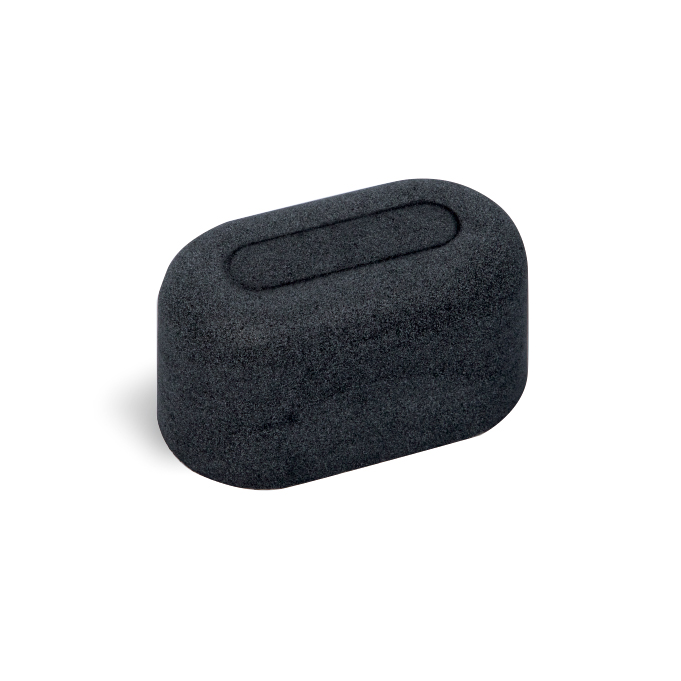
This is a replacement filter cartridge for household water pitchers and portable filter bottles, made by Oltaven. Inside a food-grade PP housing it combines high-iodine coconut-shell granular activated carbon with ion-exchange resin, so one cartridge adsorbs residual chlorine and off-tastes, softens tap water by reducing calcium and magnesium scale, and helps intercept heavy metals such as lead and copper. It is made for appliance brands, water-treatment brands, distributors and private-label sellers who need a finished cartridge rather than loose media.
Activated carbon is often described as if the material alone decides the result. In a pitcher cartridge it does not. The same coconut-shell carbon can end up in a fast-draining cartridge that lets water pass almost untouched, or in a slow one that releases fine carbon dust into the glass. What separates the two is how the media is packed and how the housing is formed around it.
Oltaven buys and qualifies media, but what we ship is a finished filter. That means the carbon granule size, the resin bead grade, the ratio in which the two are blended, the density of the fill, the injection-moulded mesh that holds the media in place, and the way the housing is sealed all sit inside one specification. Change any of them and the finished performance changes — efficiency, resistance and capacity move together.
This is why we treat media selection and forming as one engineering task. The media set the ceiling on what the cartridge can remove; the forming decides how much of that ceiling the user actually reaches in a pitcher on a kitchen counter.
High-iodine coconut-shell carbon gives a large internal pore volume, which is what makes fast chlorine uptake and odour removal possible. Ion-exchange resin works on a different principle: it exchanges hardness ions and can bind certain heavy metals. Because the two do different jobs, the blend ratio is a design decision, not a fixed recipe. A cartridge aimed at lead reduction carries a different ratio from one aimed mainly at scale and taste, and Oltaven adjusts that ratio per project.
Pitcher cartridges run on gravity, so the water has no pump behind it. The precision-moulded mesh has to be open enough for water to seep down at a usable rate, yet fine enough to keep carbon fines inside the housing. Get that balance wrong and the cartridge either trickles or clouds the water. Our moulded strainer design is built for both: an even gravity flow and no black water during use. The housing itself is food-grade PP, and the outer shape can be produced from a customer-specific mould.
A cartridge that performs well in a sample and poorly in mass production usually has a filling or sealing problem, not a media problem. Controlled fill density and a closed housing keep the media bed from shifting, channelling or leaking fines. This is why Oltaven fills and closes cartridges in cleanroom space rather than treating the housing as simple packaging.
In every case the cartridge is a consumable, so the replacement rhythm and the cost per litre matter as much as the first-use result. OEM buyers usually specify both together.
| Item | Detail |
|---|---|
| Product name | Dechlorination water pitcher filter cartridge / drinking bottle filter cartridge |
| Core filtration materials | Food-grade PP housing + high-efficiency coconut-shell granular activated carbon + ion-exchange resin |
| Core purification functions | Strong adsorption of residual chlorine, colours and odours; water softening (removal of calcium and magnesium scale); interception of harmful heavy metals such as lead and copper; filtration of sediment, rust and suspended solids |
| Flow and filtration characteristics | Precision injection-moulded strainer designed for good gravity-fed seepage speed while preventing internal carbon fines from leaking; no black water during use |
| Main end applications | Household water pitchers, portable sports filter bottles, filter components for desktop instant-heating dispensers, built-in tank cartridges for capsule coffee machines |
| Media ratio and mould customisation | 100% OEM flexible custom manufacturing supported; the activated carbon to resin mixing ratio can be adjusted for target lead-reduction or descaling requirements; housing shape fully supports customer-specific injection moulding |
| Quality and safety systems | Produced in the company's 20,000 m² cleanroom space, in line with international drinking-water and food-contact safety standards; the company holds ISO 9001/14001 and IATF 16949 certification |
Oltaven has more than 20 years of filtration product development and manufacturing experience, and has been exporting to Europe, the United States, Japan and South Korea for over 20 years. Our OEM/ODM work is the centre of what we do: sizes, structures, media grades, housing materials, logos and packaging can all be customised, and we have developed more than 1,000 filtration solutions to date.
The plant covers 50,000 m², including six cleanrooms totalling 20,000 m², where cartridge filling and sealing take place. Our own laboratory is CNAS-accredited and can issue test reports on filtration efficiency, dust-holding capacity and resistance. The company is certified to ISO 9001, ISO 14001 and ISO 45001, and obtained IATF 16949 automotive quality management certification in 2024. Products meet REACH and RoHS requirements and compliance documents are available.
Quality control runs through IQC, IPQC and OQC at every stage, across multiple automated production lines with monthly capacity in the millions of pieces. The factory is in Zhongshan, Guangdong, China.
To quote accurately we need a few details: the pitcher, bottle or appliance model the cartridge fits, the size or a drawing, the expected water flow, your operating conditions (source water and typical daily volume), and the order quantity. Send them through our contact page and our engineering team will come back with a specification and a sample plan.
Size says little about flow, because gravity-fed cartridges depend on the moulded strainer's openness, the fill density of the media bed and the carbon-to-resin ratio. A denser fill slows seepage but can improve contact; a more open strainer speeds it up but risks letting fines through. Oltaven tunes these three together so the cartridge drains at a usable rate without releasing carbon dust.
Coconut-shell activated carbon handles residual chlorine, colours and odours, while ion-exchange resin works on hardness and certain heavy metals such as lead and copper. Raising the resin share favours descaling and lead reduction; raising the carbon share favours taste and chlorine removal. The ratio is set per project against your target function.
Yes. For business customers with a defined project we provide standard samples for performance and market evaluation, with freight normally covered by the customer. For custom housings, our engineers produce samples from your drawing or reference sample and support them with test reports from our CNAS-accredited laboratory.
MOQ is typically 1,000–2,000 pieces depending on specification and packaging; custom models are usually advised from 5,000 pieces. Standard items ship in about 7–15 days, while OEM production runs generally take 25–35 days from confirmation. Scheduling is flexible because production is in our own Zhongshan factory.
Under standard household use of roughly 2–4 L per day, one cartridge lasts up to 150 L, or about 1–2 months. Heavier use or harder source water shortens that interval, so replacement guidance should be set per market on the packaging.
Our coconut-shell carbon cartridges remove over 95% of residual chlorine in tap water, and also adsorb colours, odours and some organic pollutants. Performance data is verified in our CNAS-accredited laboratory, and reports on efficiency, capacity and resistance can be issued for your technical file.
It starts with a brief: the device or bottle the cartridge fits, the function priority, and the destination market's requirements. From there we agree media grade, ratio, housing geometry and fill density, then move to samples, tooling if needed, and validation. Send these details through our contact page and we will respond with a specification and sample plan.
Cartridges use food-grade PP housings and are produced in 20,000 m² of cleanroom space. The company holds ISO 9001, ISO 14001 and ISO 45001 certification, obtained IATF 16949 in 2024, and products meet REACH and RoHS requirements with compliance documents available. We are glad to discuss which documents your market needs — just send us an inquiry.